



The EU Packaging and Packaging Waste Regulation (PPWR) applies from 12 August 2026. If you sell packaged food into the EU, the question that matters is not just whether you understand the rules. It is whether the supplier making your packaging can actually meet them, and prove it, before the deadline.
Many cannot. In May 2026, more than 130 EU businesses signed a letter asking the European Commission to postpone enforcement, citing a readiness gap across the packaging value chain. The Commission declined and held the date. That leaves a clear divide: suppliers that prepared early, and suppliers still scrambling. If your packaging comes from the second group, your product’s access to the EU market is the thing at risk, not theirs.
This guide explains what the PPWR requires of plastic food packaging, the specific questions to ask your current supplier, and why switching to a compliant manufacturer is usually faster and lower-risk than waiting for an unprepared one to catch up. It is written from a manufacturer’s perspective, so the focus is on the sourcing decisions you can act on now.
Table of Contents
What Is the PPWR and When Does It Apply?
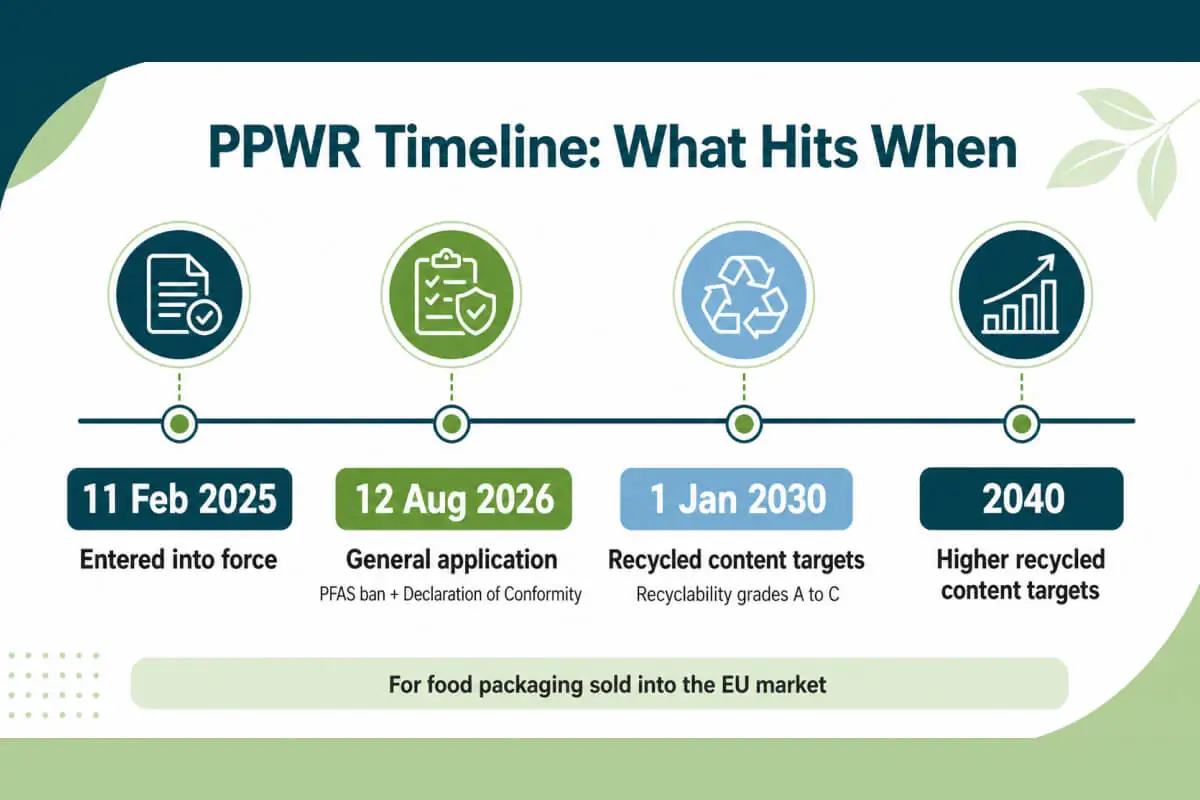
The Packaging and Packaging Waste Regulation, formally Regulation (EU) 2025/40, replaces the older Packaging and Packaging Waste Directive. According to the European Commission, it entered into force on 11 February 2025 and applies from 12 August 2026, with some specific obligations phased in on later dates.
The shift from a directive to a regulation matters. A directive sets goals that each member state implements in its own way, which is why packaging rules used to differ across the EU. A regulation applies directly and uniformly in every member state, so a single set of requirements now governs the entire EU market.
The PPWR covers the full packaging life cycle: how packaging is designed, what it is made from, how it is labelled, and how it is recovered at end of life. It applies to all packaging placed on the EU market regardless of where it is produced. That last point is the one most non-EU suppliers miss, and it is covered in detail below.
Where Things Stand in Mid-2026
The deadline is not theoretical and it is not moving. In March 2026 the Commission published its first guidance document and FAQ, and on 5 June 2026 it issued a further 58-page Commission Notice (C(2026)3702) clarifying how the regulation applies in practice, including PFAS restrictions, recyclability, and the proof needed to demonstrate compliance. Between those two documents, the pushback peaked: in late April more than 130 companies signed a letter requesting a delay, and several member states asked for urgent clarification. The Commission did not move the date.
Two clarifications matter most for food packaging. First, there is no grace period to sell through old stock under the PFAS rule. Food-contact packaging placed on the market before 12 August 2026 may remain until existing stock is exhausted, but anything placed on the market after that date must comply, even if it was manufactured earlier. Second, the Commission has confirmed there is still no harmonised EU method for calculating PFAS in food packaging, so compliance currently rests on a stepwise total-fluorine testing approach rather than a single fixed standard. In practice, that means a supplier needs to be producing compliant, tested packaging now, not in August.
The readiness gap is the real story of 2026. The rules are settled. What is not settled is whether every supplier can meet them in time. For a buyer, that turns supplier selection into a risk decision rather than a procurement formality, because the enforcement mechanism is market access: packaging that cannot be proven compliant simply cannot be placed on the EU market, and that liability flows up the chain to the brand owner, not just the supplier.
Recycled Content Requirements for Plastic Food Packaging
The PPWR sets mandatory minimum recycled content for plastic packaging, measured as an average across what a manufacturing plant produces in a year. Food packaging falls into the contact-sensitive category. The targets phase in at two milestones:
| Packaging type | By 2030 | By 2040 |
|---|---|---|
| Contact-sensitive packaging made primarily from PET | 30% | 50% |
| Contact-sensitive packaging made from other plastics (excl. SUP beverage bottles) | 10% | 50% |
| Single-use plastic beverage bottles | 30% | 65% |
| Other plastic packaging | 35% | 65% |
Recycled content under the PPWR means post-consumer recycled material, not manufacturing scrap. These targets are set out in Article 7 of the regulation. There are exemptions, including for compostable packaging, for any plastic component that makes up less than 5% of the total weight of a packaging unit, and for certain sensitive categories such as packaging for foods intended for infants and young children. There is also a safety-first exemption: where adding recycled content would push a food package out of compliance with food contact safety rules, safety takes priority over the recycled content target.
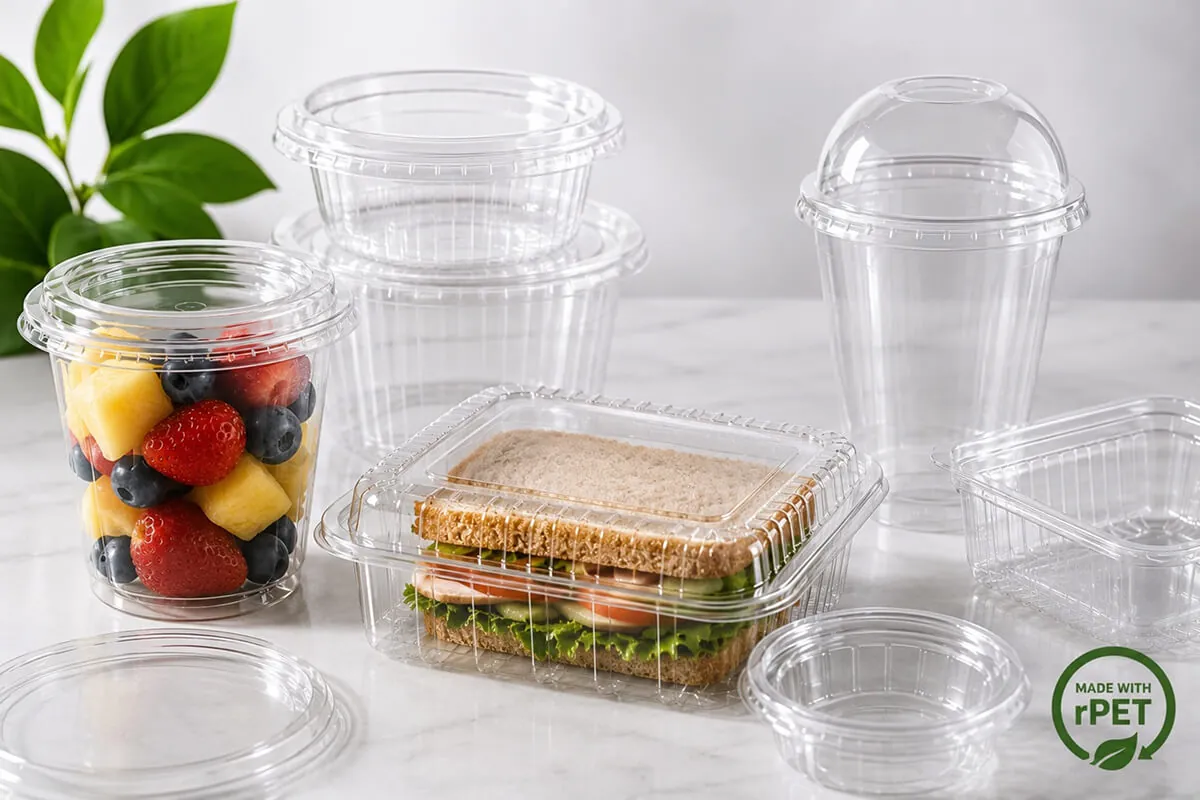
In practice, the 2030 target of 30% recycled PET is well within reach for buyers sourcing recycled PET today. SPI supplies food packaging with post-consumer recycled PET content at 10%, 30%, 50%, 70%, and 100%, which means the regulatory floor is a starting point rather than a ceiling.
The PFAS Ban on Food-Contact Packaging
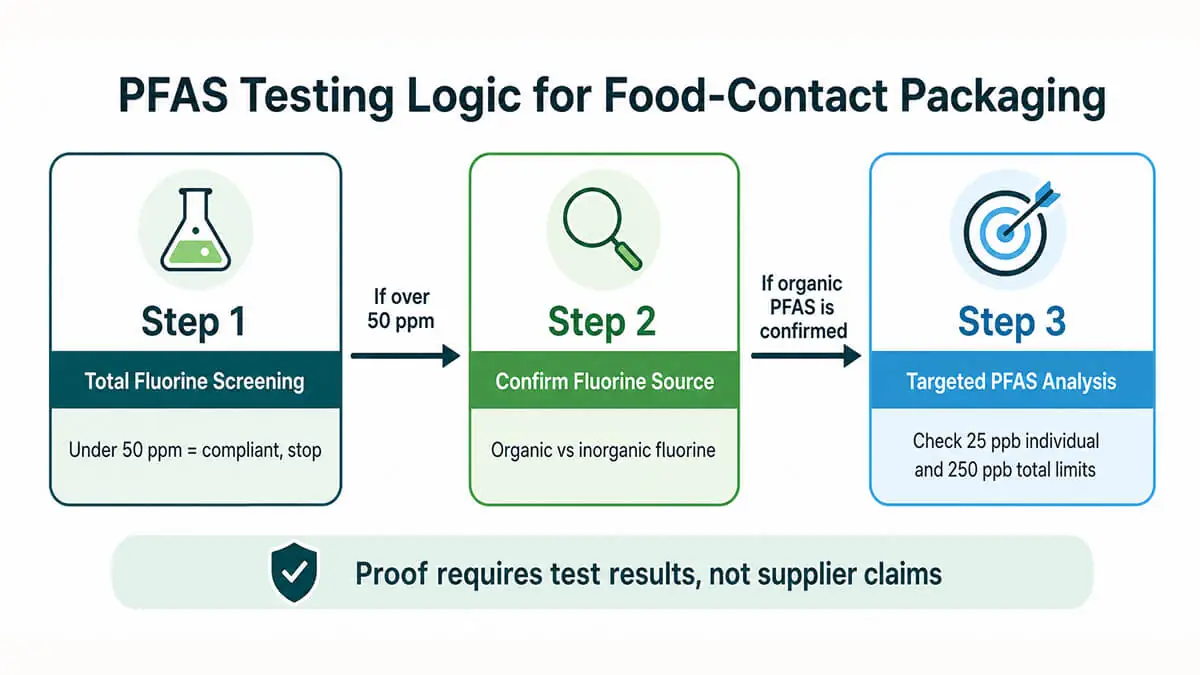
From 12 August 2026, the PPWR prohibits placing food-contact packaging on the EU market if it contains per- and polyfluoroalkyl substances (PFAS) at or above defined limit values, under Article 5 of the regulation. PFAS are a large group of synthetic chemicals, often called forever chemicals because they do not readily break down. The regulation sets three thresholds: 25 parts per billion for any individual PFAS measured by targeted analysis, 250 parts per billion for the sum of PFAS measured by targeted analysis, and 50 parts per million for total PFAS including polymeric PFAS. Polymeric PFAS are excluded from the first two targeted measurements.
There is no transition period and no allowance for selling through existing stock. Food-contact packaging that exceeds the PFAS limits cannot be placed on the market after the deadline, even if it was produced before it.
PFAS have historically been used as grease and moisture barriers, most often in fiber-based and paper packaging for oily or wet foods. This is where the rules create a practical advantage for rigid PET and PP food containers. These materials do not rely on fluorinated coatings to resist grease and moisture, so they are far less likely to carry PFAS than coated paper formats. That is a real advantage, but it is not, by itself, compliance.
A supplier saying “it’s PFAS-free” is not proof.
Under the PPWR, compliance must be shown with accredited-laboratory test results held in the technical documentation, per packaging type, not per product line. If a packaging type has no test result on file, it is treated as non-compliant regardless of what it actually contains. Accredited-lab PFAS testing currently runs 8 to 14 weeks, so a supplier that has not started testing as of mid-2026 may not have results before the deadline.
Recyclability and Declaration of Conformity Obligations
The PPWR requires that all packaging on the EU market be recyclable. The detailed criteria are being finalised through delegated acts, with design-for-recycling grades (A to C) applying from 2030 and a stricter recycled-at-scale standard from 2035. The direction is clear even while the fine print is still being written: packaging that cannot be recycled will face escalating restrictions and higher fees.
PET is one of the most widely collected and recycled plastics, identified by resin code 1, which positions PET food packaging well against the recyclability requirement. Every container SPI manufactures is designed to be recyclable, with no tear-off strips or mixed-material elements that complicate recovery.
The PPWR also introduces a documentation obligation. Manufacturers must hold technical documentation and issue an EU declaration of conformity stating that their packaging meets the regulation. This declaration is needed for packaging placed on the EU market from the application date, and the data behind it often has to be gathered from across the supply chain, which takes time. Buyers should be asking suppliers for this now rather than at the deadline.
Five Questions to Ask Your Current Supplier
The fastest way to find out whether your packaging is at risk is to put a few direct questions to your current supplier. Vague or delayed answers are the warning sign.
Put these five questions to your current supplier
- Can you provide the documentation we need for our Declaration of Conformity, including the technical information behind the packaging you supply?
- What certified percentage of post-consumer recycled content can you supply, and which body verified it: SCS, GRS, or ISCC PLUS?
- Can you provide accredited-laboratory PFAS test results for the packaging types we buy? A written assurance that it is PFAS-free is not the same as a test report, and the regulation requires the report.
- Is the packaging designed to be recyclable under the design-for-recycling criteria, with no mixed-material elements that complicate recovery?
- If we need to raise recycled content over time toward the 2040 targets, can you scale with us without retooling or redesign?
A prepared manufacturer answers all five without hesitation and can back each answer with a document. If your supplier cannot answer these clearly today, the gap will not close on its own before August. The documentation alone can take weeks to assemble, and a supplier that has not started is not going to be ready in time. That is the moment to evaluate alternatives rather than hope.
Switching Suppliers Is Lower-Risk Than Waiting
The instinct under deadline pressure is to stay with a known supplier and hope they catch up. For PPWR, that instinct often carries more risk than switching, because the thing that feels safe (waiting) depends on someone else’s readiness, while the thing that feels disruptive (changing suppliers) is more straightforward than most buyers expect.
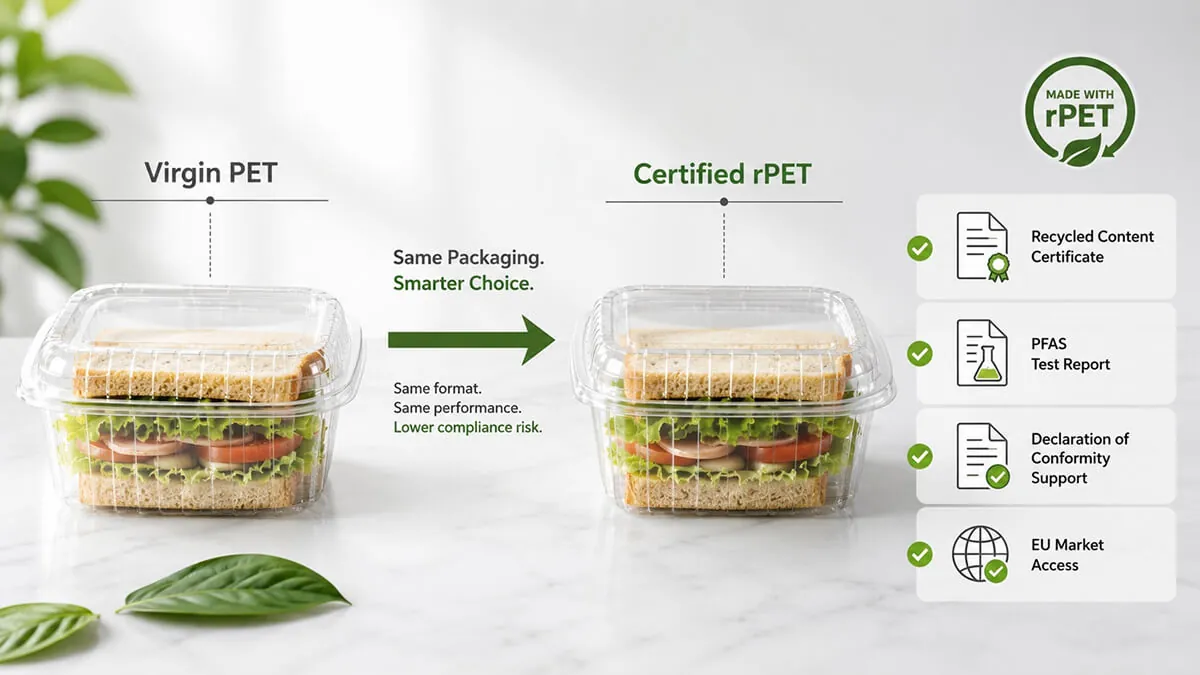
The technical barrier to switching is low. rPET runs on the same thermoforming equipment as virgin PET, and existing container formats usually do not require new molds. In most cases the container shape, dimensions, and function stay the same, and only the material specification changes. A manufacturer that controls its own sheet extrusion and thermoforming can adjust recycled content percentage and handle the transition internally, without asking the buyer to redesign anything.
What you gain by switching to a prepared supplier is certainty: certified recycled content, the documentation your conformity assessment depends on, and a supplier already set up to provide PFAS test results, all in place before the deadline rather than promised after it. For a buyer whose product cannot legally enter the EU market without compliant packaging, that certainty is worth more than the familiarity of a supplier who is still scrambling.
Does the PPWR Apply to Non-EU Manufacturers?
Yes, in effect. The PPWR applies to packaging placed on the EU market regardless of where it was produced or sold from. A food brand in any country that ships packaged product into the EU is responsible for ensuring that packaging complies. A non-EU supplier is not outside the regulation simply by being based elsewhere; the packaging they supply still has to meet the rules once it reaches the EU market.
For food brands that export to Europe, this means the compliance question travels with the product. Sourcing packaging from a manufacturer that already understands PPWR requirements and can supply compliant recycled content with the documentation to prove it removes a significant risk from the supply chain. The same logic extends to the UK: under the Windsor Framework, most PPWR provisions also apply to packaging placed on the Northern Ireland market, creating a dual regulatory picture for UK producers.
This is already changing how buyers evaluate suppliers. Across the industry, procurement teams are no longer asking only about price and product quality; they are asking whether a supplier can prove its packaging credentials in a format a regulator will accept, and some converters now market PPWR readiness as a reason to choose them. A supplier that cannot answer the documentation question is quietly becoming a liability rather than just a cost line.
How to Verify Compliance: Certifications That Matter
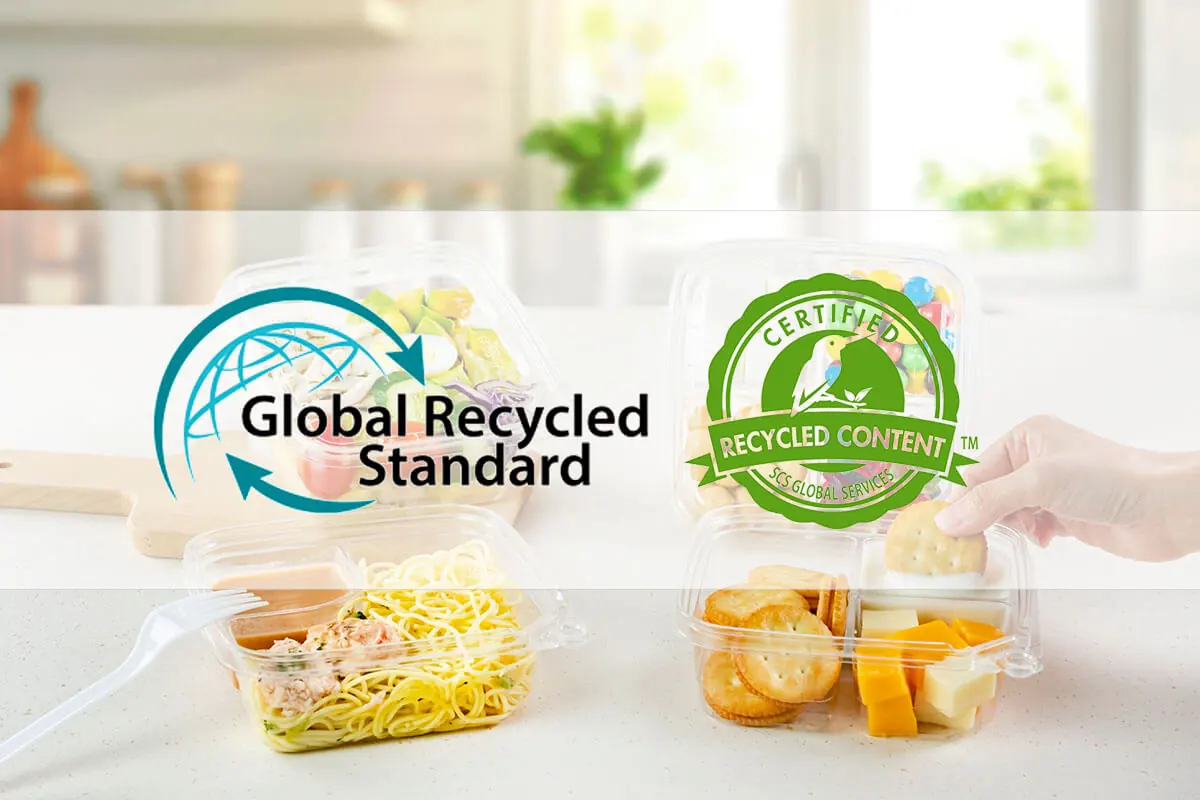
The PPWR raises the stakes on recycled content claims, because a claim that cannot be verified is now a compliance and reputational risk rather than just a marketing weakness. Third-party certification is how buyers close that gap. Three certifications are most relevant for recycled and bio-based food packaging:
- SCS Recycled Content Certification verifies the exact percentage of post-consumer recycled content in a product, audited across the chain from input material to finished packaging.
- Global Recycled Standard (GRS) tracks recycled content through the entire supply chain and confirms the claimed percentage is accurate and auditable.
- ISCC PLUS covers chemically recycled rPET and bio-based plastics such as Bio-PP, using mass balance accounting to match certified material entering production with what is claimed on the finished product.
When evaluating a supplier, ask three direct questions: which body verified the recycled content claim, what specific percentage is certified, and whether they can provide the certificate. If any answer is vague, the claim may not hold up under scrutiny from regulators or your own customers.

How SPI Helps Food Brands Meet PPWR Requirements
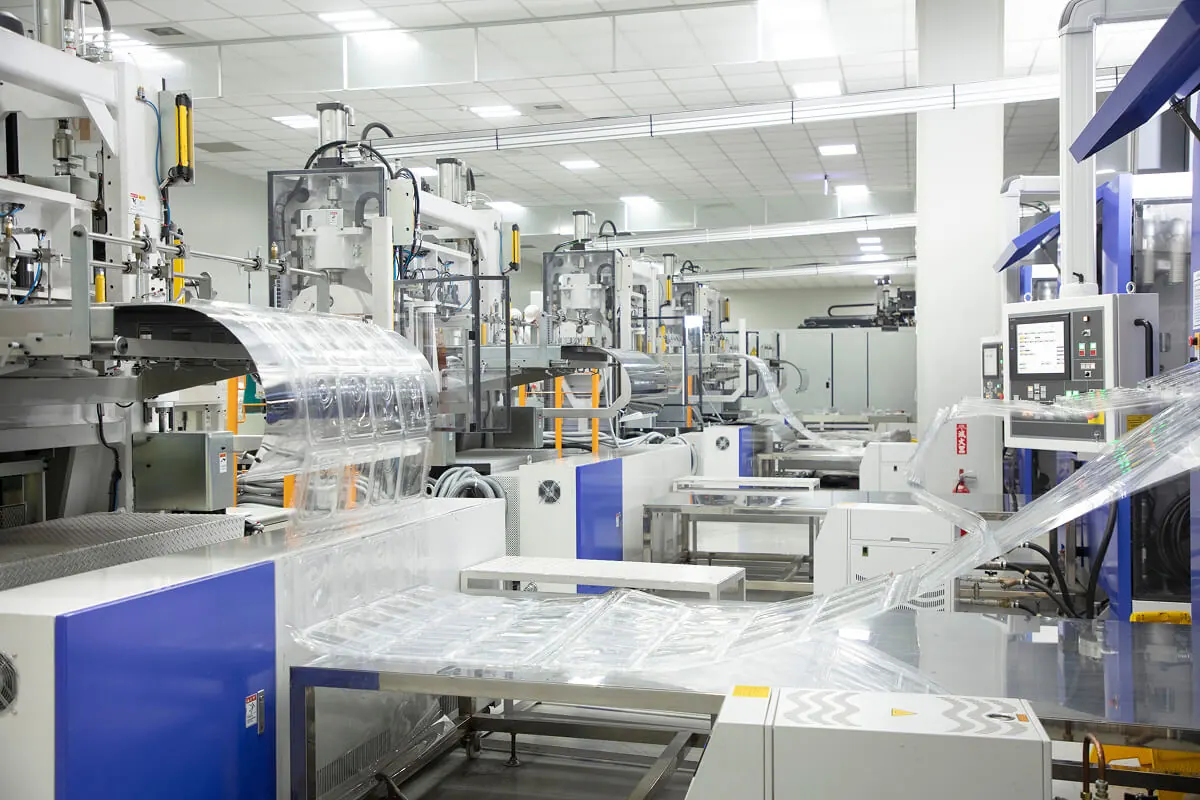
SPI has manufactured thermoformed food packaging since 1983, and recycled content is built into the production infrastructure rather than added on. We supply food packaging with post-consumer recycled PET at 10%, 30%, 50%, 70%, and 100%, all certified by SCS Global Services and verified under the Global Recycled Standard. Through ISCC PLUS certification, we also offer chemically recycled rPET and Bio-PP made from non-edible plant feedstock, both tracked through mass balance accounting. On recycled content, that puts buyers well ahead of the PPWR’s 2030 targets rather than scrambling to reach them.
Because we control sheet extrusion and thermoforming in-house, we can adjust recycled content percentage and container design without depending on outside sheet suppliers, which makes it straightforward for buyers to scale recycled content up over time as targets tighten toward 2040. We also handle the switch from virgin PET or from another supplier internally, on existing tooling where possible, so changing suppliers does not mean redesigning your packaging. Our 100% recycled PET line, respire, is one example, and all packaging is produced in our BRCGS , HACCP, and ISO certified facility.
On PPWR specifically, it is worth being precise about roles. Under the regulation, the party that places packaging on the EU market, usually the brand owner, is the one that issues the Declaration of Conformity. The manufacturer’s job is to supply the certified data and supporting documentation the brand owner needs to do that: recycled content certificates, food contact compliance, and material information. That is the role SPI fills. We work with buyers to provide the documentation behind their conformity assessment rather than leaving them to chase it from an unprepared supplier at the deadline.
If you are not certain your current packaging will be compliant on 12 August, contact SPI to review your formats, discuss certified recycled content options, and get the supporting documentation your conformity assessment will need.