




When a food brand evaluates a packaging supplier, certifications are the shortcut for trust. They are how a buyer confirms, without visiting the factory, that a manufacturer meets food safety and sustainability requirements. The problem is that the certification landscape is confusing by design, with overlapping schemes, benchmarking bodies that are not themselves certifications, and recycled content standards that verify different things. This guide explains the certifications that actually matter for food packaging, across both food safety and sustainability, and what each one proves.
Table of Contents
Food safety certifications: what GFSI, BRCGS, FSSC 22000 and ISO 22000 actually mean
Food safety certifications prove that a manufacturer produces packaging under controlled, hygienic, traceable conditions. Here is how the main terms fit together.
GFSI is a benchmark, not a certificate
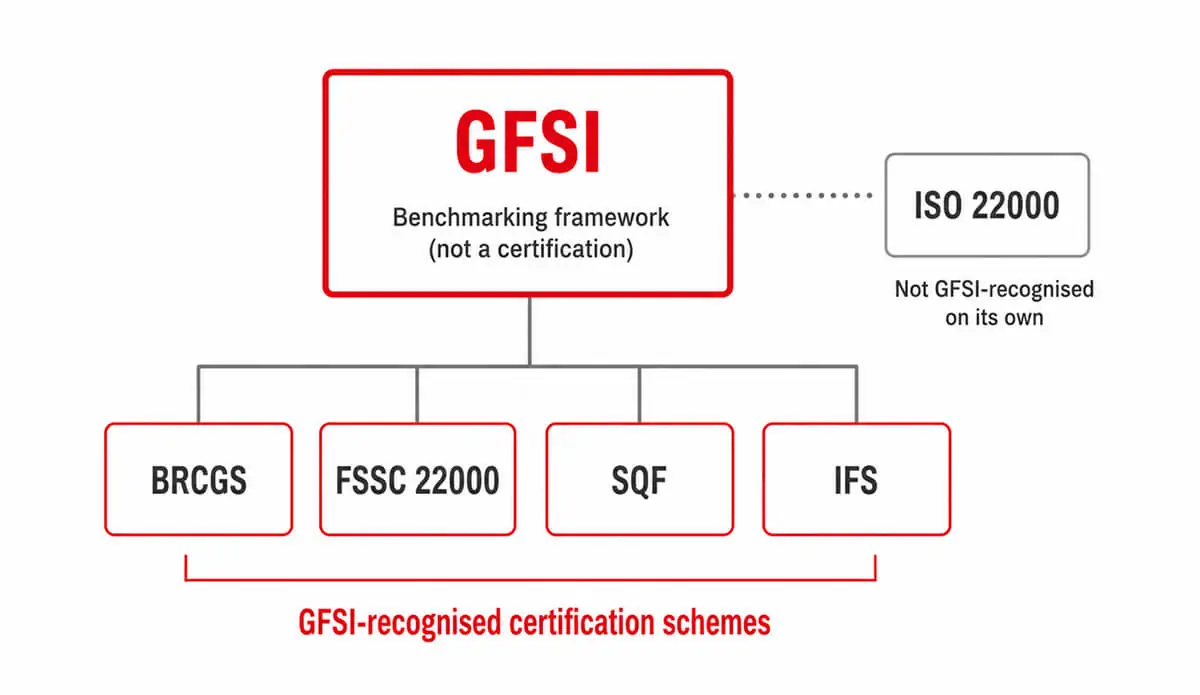
The Global Food Safety Initiative (GFSI) is an industry body that benchmarks food safety schemes against a common set of requirements. A supplier cannot be “GFSI certified” directly. Instead, GFSI recognises specific schemes, and holding one of those schemes is what makes a supplier GFSI-benchmarked. The major GFSI-recognised schemes are BRCGS, FSSC 22000, SQF and IFS. GFSI benchmarking is based on food safety criteria, and its main practical value is global acceptance: a GFSI-recognised certificate is trusted across international trade, so a buyer does not have to evaluate the scheme from scratch.
BRCGS
BRCGS, formerly the BRC Global Standard, is a prescriptive, retailer-driven standard focused on product safety, integrity, legality and quality. For food packaging specifically, the relevant version is the BRCGS Global Standard for Packaging and Packaging Materials, which was the first packaging standard to be recognised by GFSI and is now in its 7th issue. It sets hygiene, contamination control, and traceability requirements designed for packaging manufacturing rather than food processing. BRCGS is the standard most commonly required by UK and European retailers, so for a manufacturer supplying supermarkets it is often the most commercially necessary certification to hold.
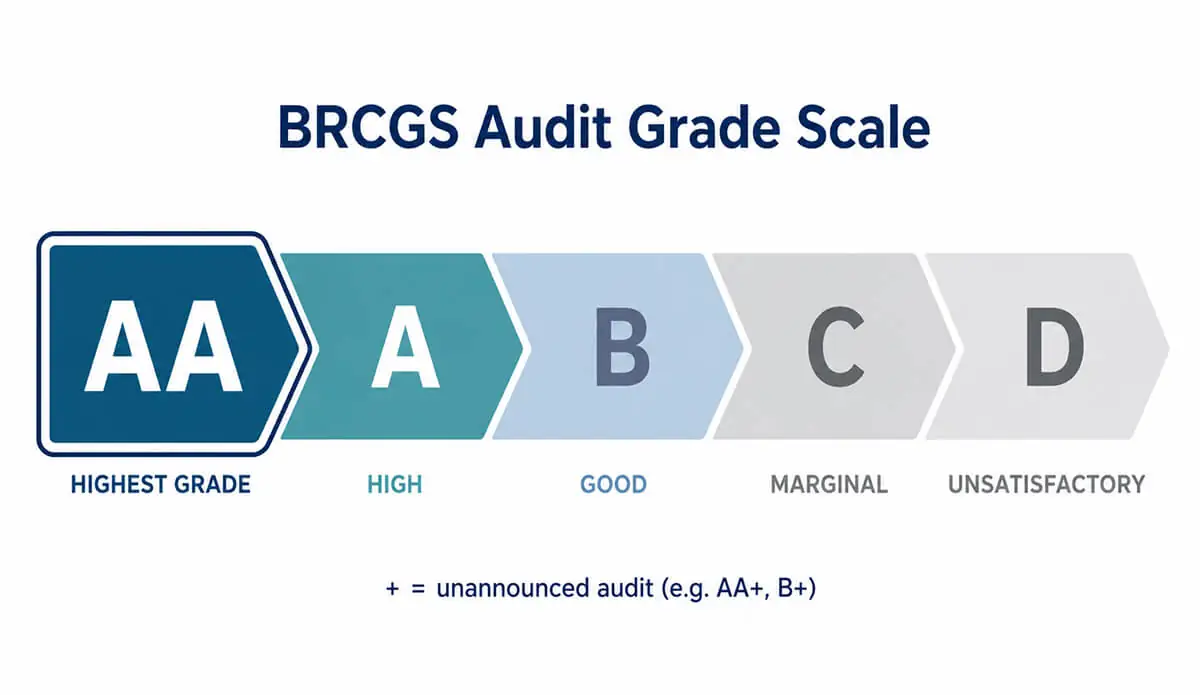
BRCGS grades audit performance on a scale of AA, A, B, C and D, where AA is the highest, with a “+” suffix marking an unannounced audit (for example AA+). So Grade A is a strong result, the second band on the scale, though not the top grade. Knowing the full scale helps a buyer read a certificate accurately rather than assuming any single grade is the ceiling.
FSSC 22000
FSSC 22000 (Food Safety System Certification 22000) is built on ISO 22000 and adds sector-specific prerequisite programmes from the ISO/TS 22002 series plus additional scheme requirements, which together earn GFSI recognition. Because of its ISO foundation, FSSC 22000 is often the natural choice for multinational manufacturers that already operate within an ISO management system. It is one of the most widely used GFSI schemes globally.
ISO 22000 on its own
ISO 22000 is the international standard for a food safety management system, built on HACCP principles. It is widely respected, but on its own it is not GFSI-recognised, because it did not meet the specific requirements of the GFSI benchmarking document. FSSC 22000 exists precisely to close that gap. A manufacturer can hold ISO 22000 as its management-system backbone and separately hold a GFSI-benchmarked scheme such as BRCGS.
HACCP
HACCP (Hazard Analysis and Critical Control Points) is the underlying methodology beneath most food safety systems. It is a systematic approach to identifying and controlling hazards in production. Rather than competing with the schemes above, HACCP is the foundation they are built on.
Which food safety certification does a packaging buyer actually need?
The honest answer is that for most buyers, the requirement is a GFSI-recognised scheme, not one specific scheme. BRCGS and FSSC 22000 are treated as equivalent evidence of a robust food safety system. The choice between them is usually driven by market and history rather than rigour:
- If you supply, or your customers supply, UK and European retailers, BRCGS is the most commonly demanded scheme, and BRCGS Packaging Materials is purpose-built for packaging.
- If your organisation is a multinational already running ISO management systems, FSSC 22000 often fits more naturally.
So when a buyer is told “our customer requires a GFSI-certified supplier,” a manufacturer certified to BRCGS Packaging Materials meets that requirement. Asking specifically for “FSSC 22000 only” is uncommon unless a corporate policy names it, because the two are recognised as equivalent.
| GFSI | BRCGS | FSSC 22000 | ISO 22000 | |
|---|---|---|---|---|
| What it is | Benchmarking framework | Certification scheme | Certification scheme | Management system standard |
| GFSI recognised? | (is the benchmark) | Yes | Yes | No, on its own |
| Packaging-specific version? | n/a | Yes (Packaging Materials) | Via ISO/TS 22002-4 | No |
| Typically required by | n/a | UK/EU retailers | Multinationals with ISO systems | General baseline |
| Basis | n/a | Retailer-driven standard | ISO 22000 + PRPs + extras | HACCP + management system |
BRCGS is not the only packaging-specific route to GFSI recognition. IFS PACsecure and SQF both have packaging codes recognised for the production of food packaging. BRCGS is simply the most widely required in the UK and European retail markets that most food packaging buyers care about.
A moving target: the BRCGS Issue 7 and BMR2024 transition
One detail is worth checking on any BRCGS certificate right now, because the standard is mid-transition. The BRCGS Packaging Materials standard moved from Issue 6 to Issue 7, which launched in October 2024 and has been audited since 28 April 2025. Separately, GFSI updated its own benchmarking requirements to a 2024 version (BMR2024), and BRCGS has confirmed that updated position statements aligning its standards with BMR2024 take effect for all audits conducted from 10 August 2026.
For a buyer, the practical takeaway is simple: when you check a supplier’s BRCGS certificate, note which issue it references and its audit date, since a certificate audited under the older issue remains valid until its cycle renews. This is not a reason to doubt a supplier, it is normal standard evolution, but it is exactly the kind of detail a thorough certification check should capture.
Food-contact compliance: the layer beneath the certifications
Before any management-system certification, food packaging has to clear a more basic legal hurdle: the material that touches food must be safe for that use. This is food-contact compliance, and it is separate from the GFSI schemes above. A factory can hold BRCGS and still have to prove, material by material, that its packaging meets food-contact law in each market it sells into.
The two reference regimes most buyers encounter are the United States and the European Union. In the US, food-contact materials are regulated by the FDA, with plastics covered under Title 21 of the Code of Federal Regulations (for example 21 CFR 177 for specific polymers). In the EU, the framework regulation is Regulation (EC) 1935/2004, with plastics governed specifically by Regulation (EU) 10/2011, which sets out authorised substances and migration limits. Other markets, including Japan, China, and Australia, maintain their own food-contact rules.
Compliance is normally demonstrated through a Declaration of Compliance (DoC), a document in which the manufacturer states that a material meets the relevant food-contact regulations, supported by migration testing that measures whether substances transfer from the packaging into food above permitted limits. When a buyer asks a supplier for food-contact evidence, the DoC plus supporting migration test data is what they should receive.
Two cautions. First, FDA or EU food-contact compliance is not a sustainability certification, and a supplier that offers food-contact approval in place of a recycled-content certificate is answering a different question. Second, from 12 August 2026 the EU PPWR bans PFAS in food-contact packaging above defined limits (25 parts per billion for any individual PFAS by targeted analysis), which means food-contact compliance in the EU now includes a documented PFAS position, not only migration testing. A supplier’s food-contact documentation should reflect that new requirement.
Sustainability certifications: what SCS, GRS and ISCC PLUS prove
The other family of certifications a food packaging buyer meets covers sustainability claims, specifically recycled and renewable content. These have become far more important as recycled content mandates like the EU PPWR approach, and the key point is that they verify different things. A supplier claiming “recycled” without naming the standard behind it is making a claim that cannot be checked.
SCS Recycled Content
SCS Global Services Recycled Content certification (standard SCS-103, currently Version 8.0) verifies the percentage of recycled material in a product, audited from input material through to finished packaging. It certifies both pre-consumer and post-consumer recycled content, of any material type, for products containing at least 5% recycled content, and it is based on the ISO 14021 definition of recycled content. Certification uses a controlled blending chain of custody, with a mass balance chain-of-custody option added in Version 8.0. An SCS certificate states a specific percentage, such as 30% or 100% recycled content, and importantly it will state whether that content is post-consumer or pre-consumer.
That post-consumer versus pre-consumer distinction matters more than it sounds, because the two are not treated equally under regulation. Post-consumer recycled content (PCR) comes from products that reached an end user and were discarded, genuine waste diverted from landfill. Post-industrial or pre-consumer recycled content (PIR) comes from manufacturing scrap that never left the factory. Under the EU PPWR, only post-consumer content counts toward the recycled content targets, so a supplier marketing “recycled content” that turns out to be pre-consumer may hold a valid certificate that is worthless for compliance. A buyer should always confirm the certificate specifies post-consumer content.
Global Recycled Standard (GRS)
The Global Recycled Standard, managed by Textile Exchange, also verifies recycled content, but goes further than percentage alone. GRS tracks recycled content through the full supply chain with chain-of-custody documentation, and adds social, environmental, and chemical criteria to the audit. GRS can be applied to products with at least 20% recycled content as a business-to-business claim, while consumer-facing GRS labelling requires at least 50%. A GRS certificate confirms not just how much recycled content is present, but that it was handled responsibly along the way.
One point of caution for buyers: SCS Global Services is itself one of the certification bodies that audits to GRS, so “SCS” and “GRS” are not two competing standards. SCS owns the SCS-103 Recycled Content standard and also certifies companies to Textile Exchange’s GRS. Worth noting too that Textile Exchange is consolidating its standards into a new Materials Matter Standard, with GRS’s requirements folding in over 2026 and 2027, so the GRS name may change in the next couple of years even though the underlying assurance continues.
ISCC PLUS
ISCC PLUS certifies sustainable, recycled, and bio-based materials, and it is broader than many buyers assume. It covers mechanically recycled, chemically recycled, bio-based, and bio-circular feedstocks, not just chemical recycling. ISCC offers three chain-of-custody options: physical segregation, controlled blending, and mass balance. For food packaging, ISCC PLUS is most often used to make chemically recycled rPET and bio-based polypropylene traceable, materials that a simple recycled-percentage check cannot capture.
Here is the part buyers most need to understand, because it is where a certificate can be misread. When ISCC PLUS is used with mass balance accounting, it verifies an accounting attribution, not the physical contents of a specific item. Mass balance lets a manufacturer attribute a quantity of certified sustainable input across its output, tracked and audited through the chain. What it proves is that a corresponding amount of certified feedstock entered the system and displaced fossil material upstream. It does not guarantee that the certified material is physically present in the particular tray you are holding. This is not a loophole, it is how mass balance is designed to work, and it is a legitimate and widely accepted method. But an honest reading of an ISCC PLUS mass balance claim is “certified sustainable input was used in a verified proportion,” not “this item physically contains X% recycled material.” A supplier or buyer who blurs that distinction is overstating what the certificate says.
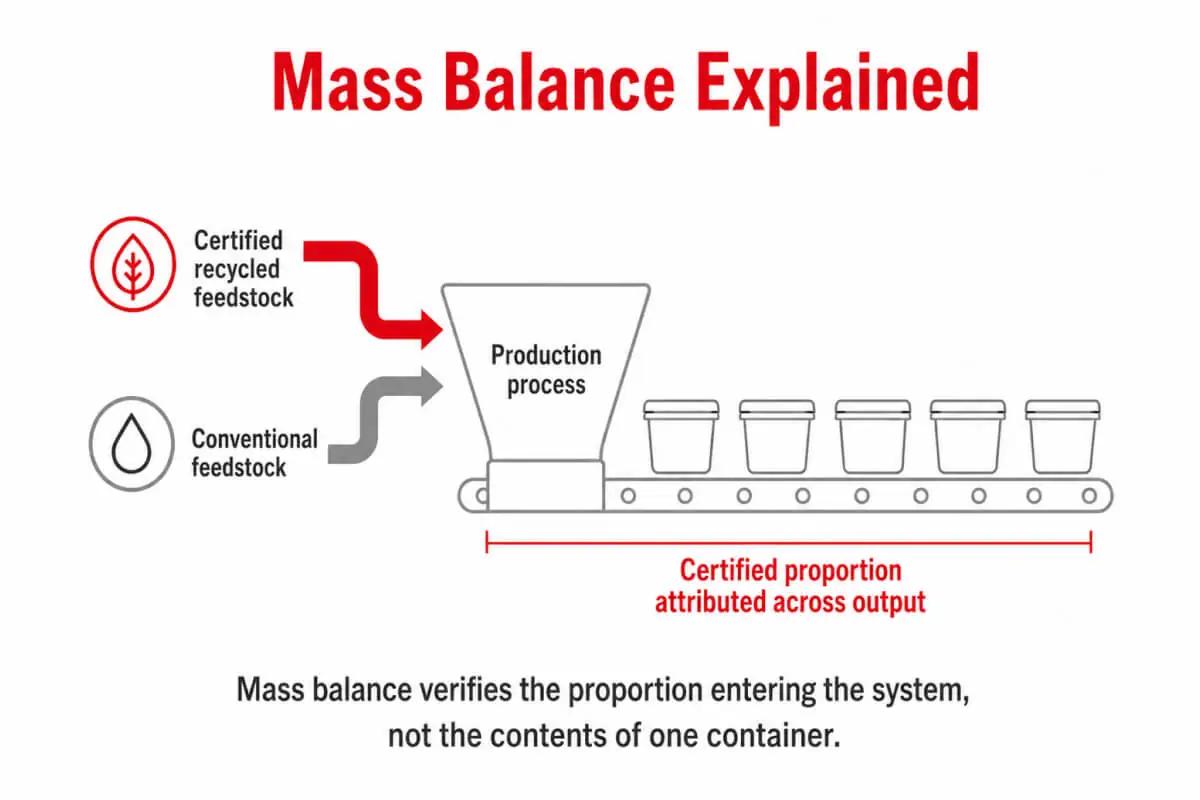
Mass balance is also central to how sustainability certification will connect to regulation. Chemical recycling is expected to be recognised toward EU PPWR recycled content targets through mass balance accounting, but the exact methodology depends on an EU implementing act still to be finalised, currently expected by the end of 2026. So ISCC PLUS may serve as a foundation for future PPWR recycled content claims, but the official method is not settled yet, and any supplier presenting it as guaranteed PPWR compliance today is getting ahead of the rules.
| SCS Recycled Content | GRS | ISCC PLUS | |
|---|---|---|---|
| Verifies | Recycled content percentage (pre- or post-consumer) | Recycled content + responsible handling | Recycled and bio-based feedstock, tracked to output |
| Chain of custody | Controlled blending, or mass balance (option, V8.0) | Full supply chain tracking | Segregation, controlled blending, or mass balance |
| Also covers | Any recycled material, min 5% | Social, environmental, chemical criteria | Mechanical + chemical recycling + bio-based |
| Best for | Proving a specific recycled % | Responsible-sourcing assurance | Chemically recycled / bio-based claims |
| Key caveat | Confirm post-consumer vs pre-consumer | 20% for B2B, 50% for consumer label | Mass balance = attribution, not guaranteed physical content |
Why “our materials are certified” is not the same as “this product is certified”
One distinction separates a substantiated claim from a weak one, and buyers should check it specifically. A supplier stating that its raw materials are certified is not the same as the finished packaging being certified. Certification has to follow through to the product that will actually hold food. This is one of the most common gaps in supplier claims, and the fix is simple: ask for the certificate that covers the finished product and the specific site that makes it, not a general material declaration.
How to verify a supplier’s certifications
Because certificates can be described loosely, five checks confirm that a claim is real:
- Named scheme, not a category. “GFSI certified” should resolve to a specific scheme such as BRCGS or FSSC 22000. “Recycled” should resolve to SCS, GRS, or ISCC PLUS, and for recycled content, confirm it is post-consumer.
- A current certificate. Certifications expire and are re-audited. Ask for the certificate with its issue and expiry dates, its certificate number, and which issue of the standard it was audited against.
- The right scope. Confirm the certificate covers food-contact packaging and the specific manufacturing site, not a sister facility or a different product line. For chain-of-custody schemes like ISCC, every site handling the certified material must hold its own valid certificate.
- Finished product, not just material. Confirm the certification applies to the finished packaging, not only to the input resin.
- A named, accredited body. A credible certificate names the certification body that issued it, such as SGS, Bureau Veritas, TÜV, NSF, DIN CERTCO, or Control Union, and that body should itself be accredited (for product certification, typically to ISO 17065, under a national accreditation body such as UKAS or ANAB). A self-declaration is not third-party certification.
A supplier that answers all five with documents is offering verified credentials. A supplier that cannot is offering a description.
You do not have to take the certificate on trust. Most schemes maintain public registers a buyer can search directly: the BRCGS Directory, the ISCC database of valid certificates, Textile Exchange’s certified-organisation directory for GRS, and SCS’s certified products listings. Checking a supplier against the issuing scheme’s own register is the single fastest way to confirm a certificate is live and genuine.
South Plastic’s certifications
South Plastic manufactures thermoformed food packaging under the BRCGS Global Standard for Packaging Materials, Issue 7, certified by SGS United Kingdom under UKAS product certification accreditation, on an unannounced audit programme. The certificate covers the extrusion and thermoforming of PP, HIPS, PLA, OPS, rPET and PET containers, including trays, bowls, lids, linings and clamshells, for food contact packaging. Buyers can verify it independently on the BRCGS Directory rather than taking our word for it.
Because BRCGS Packaging Materials is a GFSI-benchmarked scheme, this meets the GFSI-recognised requirement that most retailers and food brands specify. It is worth being precise here: SPI holds BRCGS, not FSSC 22000. The two are recognised as equivalent routes to GFSI recognition, so a buyer whose requirement is “a GFSI-certified packaging supplier” is met by SPI’s BRCGS certification.
Alongside BRCGS, SPI operates under HACCP, ISO 22000, ISO 9001, ISO 14001, ISO 45001 and ISO 50001.
On the sustainability side, SPI’s recycled content is independently verified rather than self-reported. SPI holds SCS Recycled Content certification from SCS Global Services for post-consumer recycled PET food packaging across six certified levels:
| Certified claim | Certificate |
|---|---|
| Minimum 10% post-consumer recycled PET | SCS-RC-20126 |
| Minimum 25% post-consumer recycled PET | SCS-RC-20127 |
| Minimum 30% post-consumer recycled PET | SCS-RC-09217 |
| Minimum 50% post-consumer recycled PET | SCS-RC-09219 |
| Minimum 70% post-consumer recycled PET | SCS-RC-09220 |
| 100% post-consumer recycled PET | SCS-RC-09221 |
Because every one of these claims is post-consumer, they count toward regulatory recycled-content targets such as the PPWR’s. That is not a technicality. A supplier certified for pre-consumer or post-industrial content holds a valid certificate that contributes nothing to a buyer’s PPWR compliance.
Alongside SCS, SPI holds:
Global Recycled Standard (GRS) 4.0, product category Packaging (PC0023), certified by SGS-CSTC under IOAS accreditation, covering extrusion, moulding, manufacturing, packing and distribution. Note that a GRS scope certificate confirms the site is certified; proof that specific delivered goods are GRS certified is provided by a Transaction Certificate covering that shipment.
On food-contact compliance, SPI issues a Declaration of Compliance confirming that its PP, OPS, PS, PET, rPET and PLA materials meet food packaging hygiene standards across multiple jurisdictions, supported by regular third-party testing. Material performance differs by polymer, so the declaration also sets out heat resistance and chemical compatibility per material, which is the practical detail buyers need when matching a container to a product. Polypropylene, for example, handles 110 to 120°C and is microwave safe; PET and rPET are rated to 60°C and are not.
This combination, food safety certification, food-contact compliance, and independently verified recycled content, is what lets SPI support a buyer’s own compliance claims with documentation rather than assurances. For the recycled-content side in more detail, see our guide to what rPET is, and for how these certifications map onto incoming regulation, our guide to PPWR readiness.
If you are auditing a packaging supplier or need to confirm which certifications apply to a specific product, contact South Plastic to request current certificates for the formats you are sourcing.