



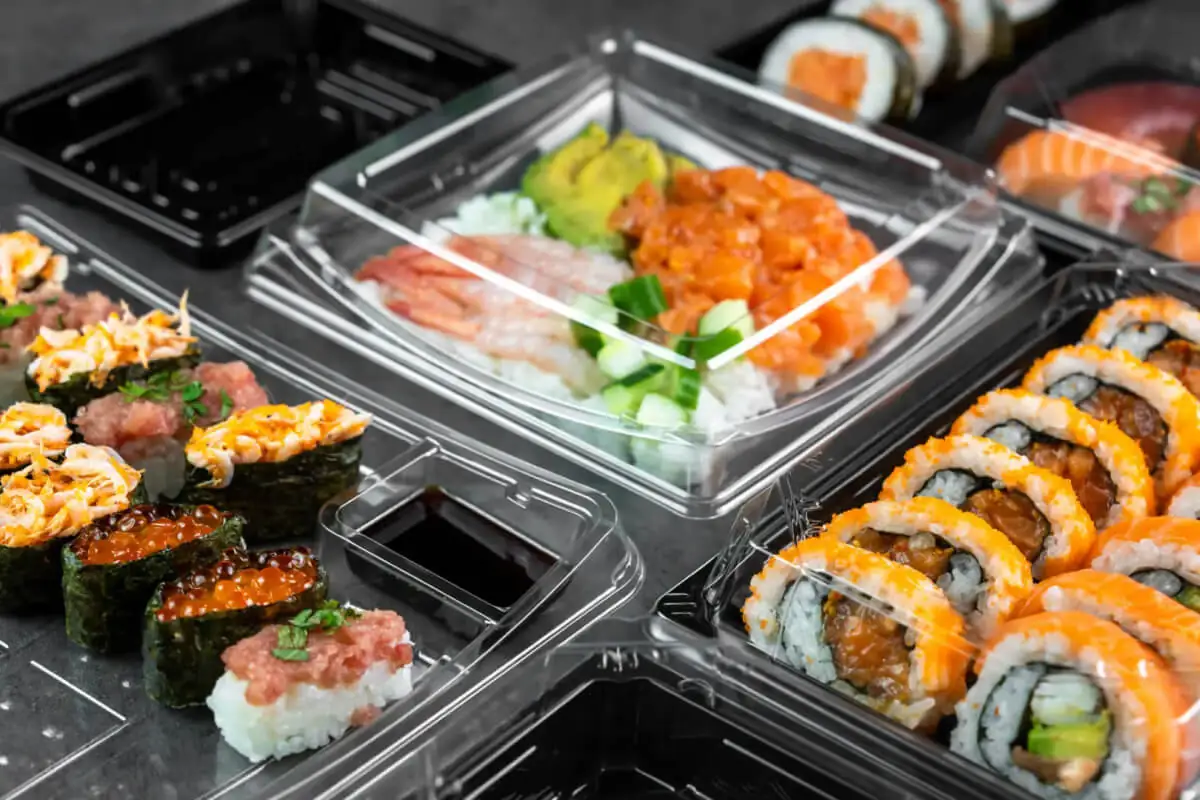
Every month we hear a version of the same question from buyers of sushi packaging: should we move our sushi to rPET, or is PS still fine? The answer depends on where the sushi is sold, and it has changed a lot in the last two years. South Plastic supplies sushi trays to Japan, Europe, North America, Australia and the Middle East, so we see all of these markets from the factory floor. Here is what we are seeing:
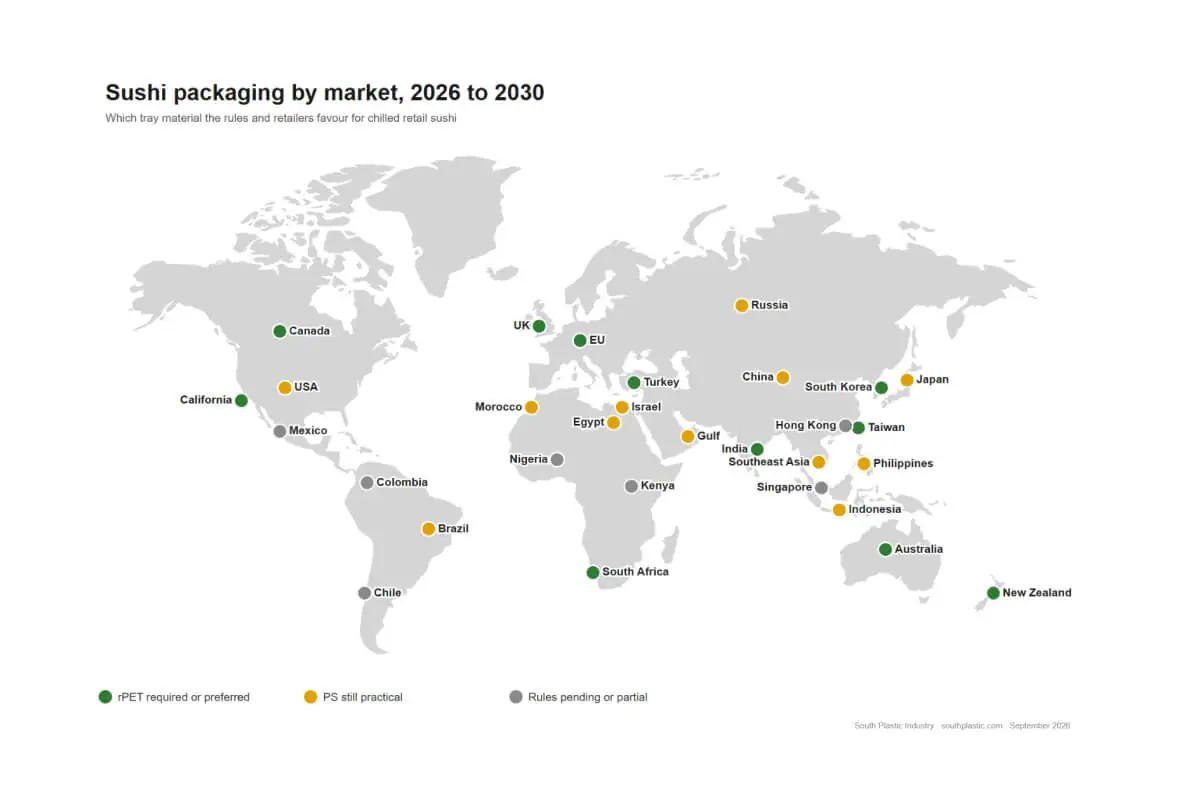
- In Europe, Australia, New Zealand, Canada and South Korea, PET and rPET sushi trays are becoming the normal choice. New rules and supermarket policies in these markets reward packaging that fits established recycling streams, and PET trays have much broader recycling acceptance than PS trays in most of these markets.
- Polystyrene (PS) trays are not banned in Europe, the US or Japan. Almost every “polystyrene ban” in the world covers foam only. The exceptions are specific: New Zealand banned PS takeaway packaging in 2022, Canada bans black food containers coloured with carbon black, and Colombia will ban all plastic takeaway food containers from 2030.
- rPET trays are actually recycled in fewer places than most buyers think, and where tray recycling is limited, PS can still be a practical choice. Australia, Japan, South Korea, Taiwan, Canada and Singapore have established collection or recycling routes for PET trays. Across the Gulf, much of Southeast Asia, Latin America, India, China, Russia and most of Africa, PET bottle recycling is far more established than PET tray recycling, so cost, presentation and local retailer requirements still matter.
- For the next two years, the lid will decide most supplier changes. When a lid moves from OPS to rPET, anti-fog and snap fit often stop working unless the supplier re-engineers them.
- Every market now asks for paperwork. Whatever the material, buyers want proof of recycled content, a recycling assessment for their country and food-contact and food-safety certificates.
Material choice gets most of the attention, but for buyers switching from PS/OPS to rPET, the harder technical problem is often the lid. Anti-fog performance, snap fit and lid retention all need to be validated on the new material, not assumed from the old OPS design.
Table of Contents
Quick market guide for sushi packaging buyers
| Market | Rigid PS today | PET/rPET direction | Main buyer issue |
|---|---|---|---|
| European Union | Generally permitted today | Strong shift to PET/rPET | PPWR recyclability grades from 2030 |
| United Kingdom | Legal | PET/rPET preferred | Recycling acceptance, EPR fees and packaging tax |
| United States | Generally legal outside specific state or local rules | Market dependent | State foam bans and California SB 54 |
| Canada | Clear rigid PS is not federally prohibited; carbon-black foodservice ware is | PET/rPET avoids the carbon-black issue | Federal single-use plastic rules and provincial fees |
| New Zealand | PS takeaway packaging is banned | PET/rPET is the practical route for takeaway sushi | 2022 takeaway ban; wider PS phase-out paused |
| Japan | PS is established | PS and PET can both be viable | Established PS tray collection and recycling |
| South Korea | Legal | PET often favoured | Recyclability grading and producer fees |
| Taiwan | Legal | PET is well established in the recycling system | Collection route and retailer preference |
| Australia | Rigid PS remains legal | PET/rPET increasingly favoured | Recycling labels, retailer targets and developing national rules |
| Gulf markets | Generally legal, with UAE and Dubai-specific restrictions | Mostly retailer-led | Limited tray recycling and local single-use rules |
Rules can apply differently depending on whether a tray is treated as retail packaging, takeaway foodservice ware or another category
Why we make sushi trays in both PS and rPET
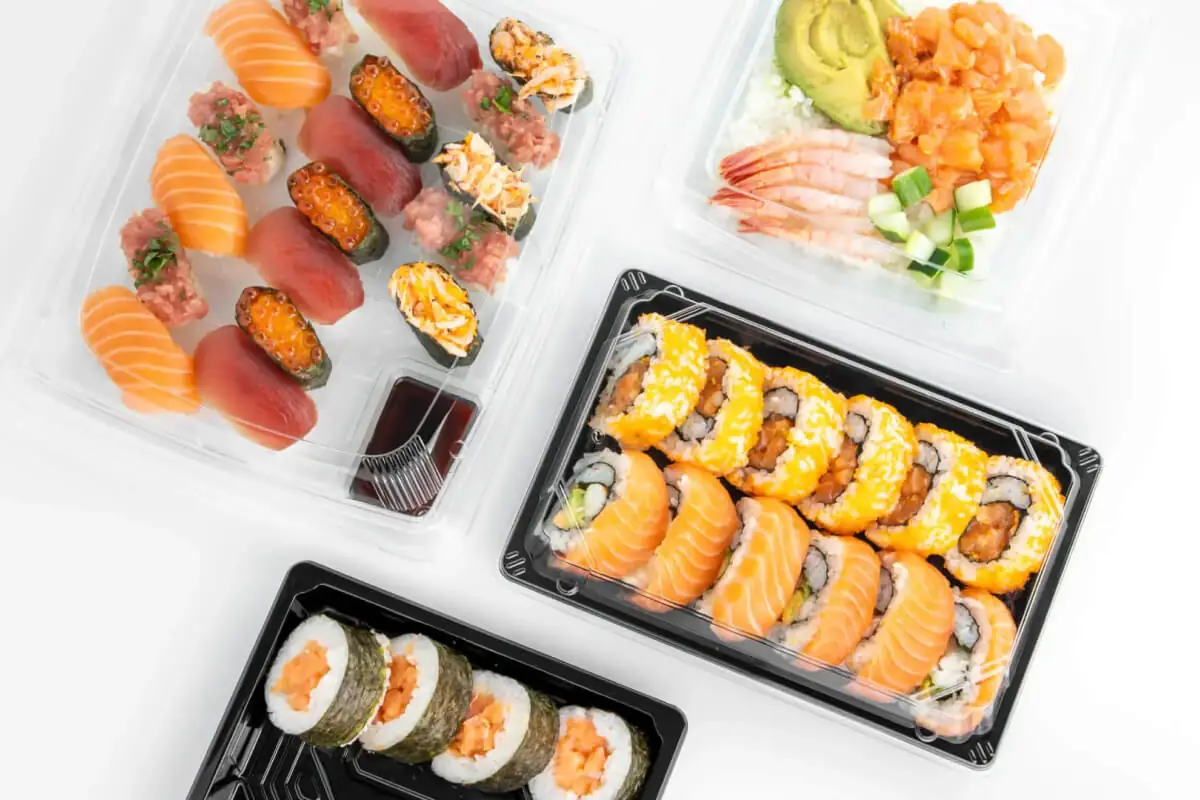
South Plastic Industry has manufactured thermoformed food packaging since 1983 supplying the Japanese retail market for more than 15 years. Our sushi tray range was developed for that market, where a printed polystyrene base with a clear anti-fog OPS lid has been the standard for decades. Japan is the one country that collects used PS trays at supermarkets and recycles them at scale, so in Japan a printed PS tray is a recycled product, not a problem.
South Plastic has also supplied supermarkets, convenience chains and foodservice companies in Europe, North America, Australia and many more countries for many years. What has changed recently is the questions those customers ask. Can the base and lid go into one recycling bin? How much recycled material is in the tray, and who verified it? Will this tray still be permitted under the rules coming in 2030?
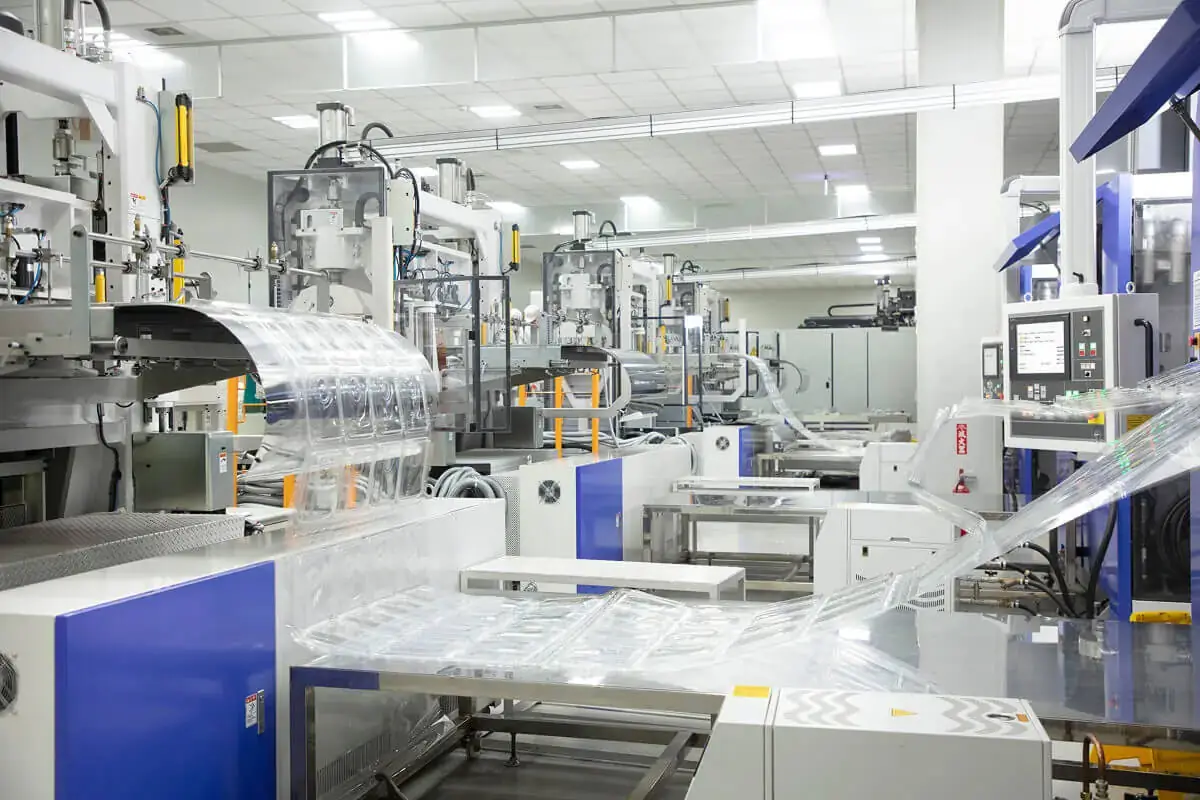
After feedback from our clients, South Plastic recently developed a second series of sushi trays in rPET. Base and lid are both rPET, plastic code 1, so the complete pack enters the PET stream wherever PET trays are collected. Recycled content is available from 10% to 100% post-consumer, verified under SCS Recycled Content and Global Recycled Standard certification, as part of the respire range. The rPET series retains the design developed for Japan: printed patterns where the market wants them, a low stacking height that came from convenience-store logistics, and sizes matched to the number of pieces. Both series are produced on South Plastic’s own extrusion and thermoforming lines in Taiwan.
The PS series remains in production because in roughly half the markets South Plastic supplies it is still the right answer. The correct material depends on where the sushi is sold. Full details of both series, with part numbers and capacities, are on the sushi trays page.
Europe: PET is becoming standard as 2030 recyclability rules approach
EU: PET is already the norm, and PPWR grading starts in 2030
European sushi packaging is already mostly PET. PET trays in Europe contain around half recycled plastic on average, according to the industry body Petcore Europe. A plant in the Netherlands turns used PET trays back into food-grade material at industrial scale, about 27,000 tonnes a year. The biggest sushi operators moved early: Sushi Daily announced in 2020 that its trays and lids were made from 100% recycled PET, starting in Waitrose stores in the UK.
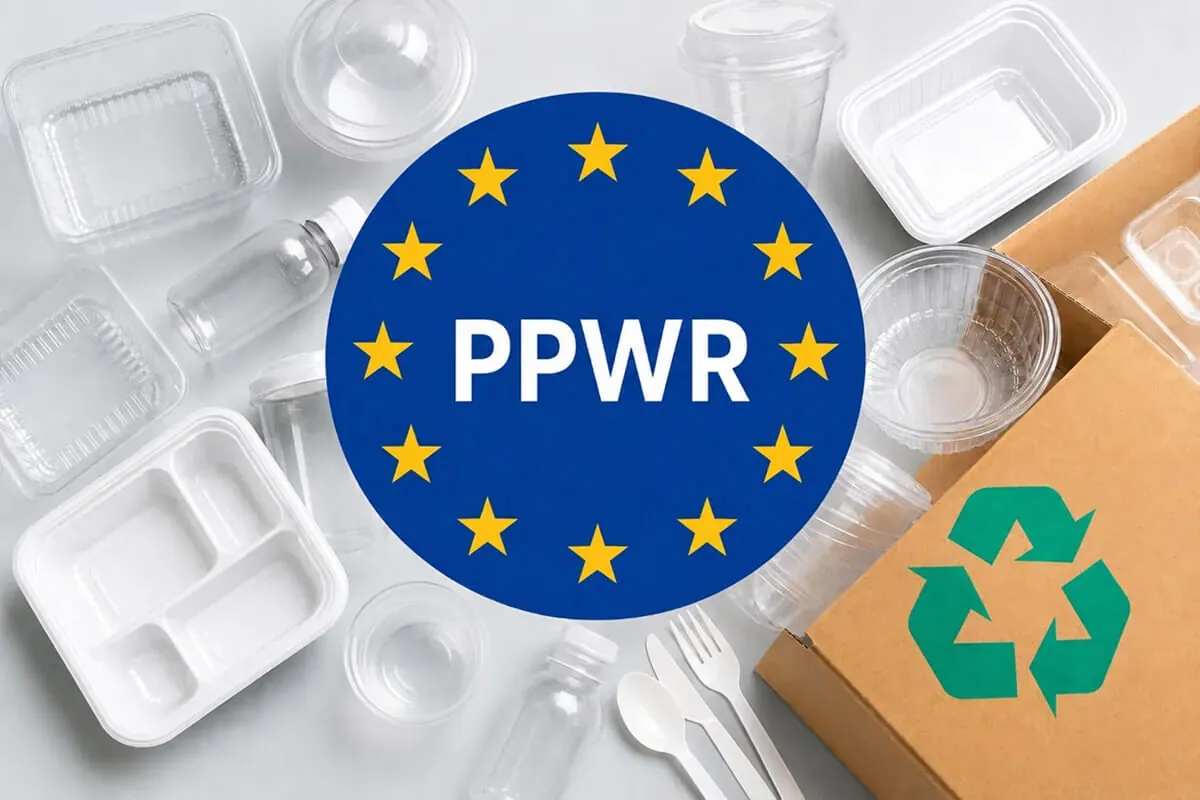
Now the law is catching up. The EU’s new packaging regulation, PPWR, applies from August 2026; we explain what it means for food packaging in our PPWR compliance guide. From 2030, packaging will need to meet the PPWR design-for-recycling criteria and achieve at least Grade C. Under the regulation’s weighting methodology, Grade A is 95% or more, Grade B is 80% or more and Grade C is 70% or more. Packaging below Grade C is treated as technically non-recyclable. From 2038, Grade C will no longer be enough, so packaging will need to reach Grade A or B to be placed on the EU market. One correction, because you will read it elsewhere: the final law has three grades, not five. The D and E grades were only in early drafts.
Nobody can grade a tray officially yet, because the detailed rules are not due until January 2028. But the direction is clear. RecyClass, the European recycling body, has said that polystyrene packaging is not yet widely recycled in Europe. France passed a law requiring PS packaging to be recyclable by 2025, and that deadline was missed. PET already has the collection, sorting and end markets in place.
UK: no council collection for PS, and a rising packaging tax
The UK is going the same way with its own rules. UK councils do not collect PS for recycling, so it goes in general waste. Producers pay the highest packaging fees for plastic that cannot be recycled. The plastic packaging tax rises to £228.82 per tonne from April 2026 for packaging with less than 30% recycled content, and from April 2027 factory scrap will no longer count toward that 30%; only post-consumer material will.
What this means in practice: supermarkets do not wait for a deadline. We expect most large European grocers to require PET or rPET for any new sushi line well before 2030, so they do not have to change the packaging again later.
North America: foam is banned, rigid PS is legal, and Canada bans black trays
United States: only foam is banned
About a dozen US states and Washington DC ban polystyrene foodservice ware. All of these bans are about foam. Rigid, clear PS trays are not covered, and Oregon’s law says so directly.
California: SB 54 sets recycling-rate tests PS is unlikely to pass
California is the state to watch. Its law SB 54 lists PS together with PET, PP and PLA as covered plastics. All covered packaging must be recyclable or compostable, and each type must reach a recycling rate of 30% by 2028, 40% by 2030 and 65% by 2032. The detailed regulations were withdrawn for rewriting in January 2026, although CalRecycle says the statutory dates stand. PS is unlikely to reach a 65% recycling rate. PET has a realistic chance: collection of PET trays and clamshells in the US and Canada grew 52% in 2024, although the recycled content actually used in new trays fell from 18% to 12%, so supply is running ahead of demand.
Canada: black trays with carbon black are banned
Canada is the market that US-focused buyers miss, and for a reason most do not expect. Canada’s federal single-use plastics rules ban lidded food containers made from foam polystyrene, PVC, oxo-degradable plastic or plastic containing carbon black pigment. Clear rigid PS is not on the list. Black is. A standard black sushi tray coloured with carbon black falls under the ban, whatever the resin. The rules survived a court challenge when the Federal Court of Appeal restored them on 30 January 2026. On top of that, provincial producer-fee schemes in Quebec and Ontario charge more for materials that are hard to recycle. For Canada, PET avoids the carbon-black issue entirely. Black trays should use a colourant that does not fall within the carbon-black prohibition.
Food safety and sourcing
Another thing to consider in North America is food safety. Retail sushi has had several Listeria recalls since 2024, including a Class I recall at Hy-Vee in 2025. Buyers have responded with stricter requirements for tamper-evident lids, leak-proof rims and date labels, especially for sushi made in a central kitchen and shipped to stores or delivered. Sushi cut fresh in a store kiosk has less of that pressure and more focus on how it looks, which is where printed PS still has a place outside Canada and California.
One note on sourcing, at the time we wrote this article plastic food containers from China carry a 25% Section 301 tariff on top of normal duty, and further China-specific tariffs have been added since 2025. Taiwan-made trays are not subject to the Section 301 rate. For US buyers, where the tray is made now matters almost as much as what it is made of. Check the current total with your customs broker, because the extra layers have changed several times this year.
Australia and New Zealand: two neighbours, two different answers
New Zealand: PS takeaway packaging banned since 2022
New Zealand went further than most markets on rigid PS. In October 2022 it banned polystyrene takeaway food and drink packaging, foam and rigid alike. Government guidance specifically lists polystyrene sushi trays among the products covered when they are used for ready-to-eat takeaway food. A third stage covering remaining PS food packaging had been due in 2025, but the government removed that deadline and the wider phase-out is on hold. In practice, sushi sold as takeaway in New Zealand already needs a PET, rPET or another compliant alternative. Supermarket sushi in rigid PS sits in a less clear area that could change if the third stage returns.
Australia: legal, but the label and the retailers favour PET
Australia has not banned rigid PS. Every state has banned foam foodservice ware, but clear or black PS trays with OPS lids are still legal. The pressure comes from other directions. The Australasian Recycling Label marks clear PET trays as recyclable in most areas and PS as not recyclable. Coles and Woolworths have both committed to fully recyclable own-brand packaging and have been moving fresh-food trays to rPET and paper since 2018. Australia’s large sushi chains now sell in clear PET or rPET trays. A national packaging regulation is being developed by the federal government, and Australia has a plant that recycles PET trays back into trays, although collection still lags behind bottles.
Asia: the most mixed picture
Japan: PS trays are collected and recycled
Japan will keep printed PS trays. Japan’s largest tray maker collects used trays at 11,600 points, mostly supermarket entrances, and turns them back into trays. The rules push for more recycled content rather than a change of material, and PS is on the approved list of food-contact plastics that became mandatory in June 2025, next to PET.
South Korea and Taiwan: PET graded and collected
South Korea has not banned PS, but every packaging item is graded for recyclability, and anything graded “difficult to recycle” must carry that label and pays 10 to 20% higher producer fees. Clear single-material PET trays grade well. A PS tray with an OPS lid needs its own assessment, so Korean buyers will ask for the grade certificate first.
Taiwan collects PET containers, including trays, through its national recycling fund. Rigid PS is legal but not preferred.
Hong Kong and mainland China: foam banned, rigid PS legal
Hong Kong banned foam tableware in April 2024 and has a second phase planned that will stop restaurants and takeaways providing plastic food containers and lids. No date is set, and packed sushi sold in supermarkets is not tableware under the law, so retail trays are not affected as things stand.
Mainland China banned foam tableware in 2020 and has not restricted rigid PS. PET bottles are recycled at very high rates, but trays are not recycled into food-grade material, and recycled PET is not yet formally approved there for direct food contact.
Southeast Asia: PS legal, producer fees rising
Across Southeast Asia, foam is banned or disappearing almost everywhere, rigid PS is legal, and PET trays are not really recycled. What is changing is cost. Producer-responsibility schemes in Vietnam (from January 2024) and the Philippines (recovery targets rising to 80% by 2028) now make producers pay for packaging they cannot recover, and Singapore requires packaging reporting and started a bottle return scheme in 2025. International retailers in the region, including AEON, Lotus’s and Don Don Donki, bring their group packaging policies with them, so rPET sells to those accounts even where local recycling cannot handle it.
Middle East, Latin America and India: PS stays practical, with exceptions
Gulf: foam banned in the UAE, rPET a retailer choice
The UAE bans foam food containers, cups, plates and cutlery from January 2026 but does not name rigid PS. Dubai’s own rule lists single-use plastic “food containers” more broadly, so check scope with Dubai Municipality before assuming a packed retail tray is exempt. Saudi Arabia and Qatar have no rules on PS trays. Almost no PET trays are recycled in the Gulf, so rPET there is a choice made by retailers, not a legal requirement.
Latin America: Colombia, Chile and Mexico City restrict containers
Latin America has the exceptions. Colombia banned foam food containers in July 2024, and the same law bans all single-use plastic containers for takeaway and delivery food from 2030, whatever the material. Chile’s single-use plastics law banned foam containers in restaurants from 2022 and was due to require reusable or certified compostable packaging for dine-in and delivery from August 2024, but that stage was delayed by a 2024 amendment; packed supermarket sushi is not clearly covered. Mexico City banned single-use plastic food containers and trays in January 2021, with an exception for compostable ones, and several Mexican states have done the same. Brazil has no national rule. In none of these countries are PET trays actually recycled, so rPET there meets the law but does not yet close the loop.
India: recycled-content requirements are rising, PS remains legal
India has not banned rigid PS. Under the Plastic Waste Management (Amendment) Rules, 2026, Category I rigid plastic packaging has mandatory recycled-content targets of 30% in 2025-26, 40% in 2026-27, 50% in 2027-28 and 60% from 2028-29 onward. The rules also contain separate obligations for importers and exemptions where recycled plastic is not permitted by food-contact or other statutory requirements. Retail sushi volume in India is small.
Russia, Turkey, Israel and much of Africa: rigid PS remains widely permitted
Russia: no PS ban, producer fees rising to a 100% recycling obligation
Russia is the largest sushi market in this group and has no ban on polystyrene. A 2021 proposal to ban 28 single-use plastic items was never adopted. Russia’s tool is producer responsibility instead: since January 2024 packaging producers and importers pay an eco-fee, and the share of packaging they must recycle rises from 55% in 2025 to 100% in 2027, with fee rates that vary by material and a large increase proposed for 2026. PET trays are not recycled in practice. Sushi delivery alone was worth about 226 billion roubles in 2023, four times the 2019 figure, and the standard tray is a PS base with a clear lid. Plastic food packaging can be imported at 6.5% duty plus VAT; confirm the treatment of Taiwan-origin goods with a Russian customs broker before quoting.
Turkey and Israel: fees in one, no tax in the other
Turkey charges a recovery contribution fee (GEKAP) on all plastic packaging by material and weight, so material choice affects cost directly, and supermarket sushi is established. Israel has no current tax on disposable plastic: an 11 shekel per kilo levy on disposable tableware was introduced in 2021 and repealed in February 2023, leaving only the general packaging law. PS trays face no legal barrier in either country.
Africa: South Africa recycles PET, the rest bans foam
South Africa is the one African market where PET is genuinely recycled: PETCO reports more than 70% of its members’ PET bottles and jars were recycled in 2024, although trays are still a small part of that. Every major grocer sells sushi, and Woolworths and Checkers have committed to recyclable own-brand packaging with recycled content. Rigid PS food packaging is outside South Africa’s producer responsibility scheme for now. Egypt and Morocco have bag-focused rules and small sushi volumes; PS remains practical. Nigeria’s Lagos State banned foam food containers in January 2024 and, from July 2025, thin single-use plastics under 40 microns. Kenya introduced producer responsibility and packaging labelling rules in late 2024, now partly held up in court, and Ghana announced plans for a foam container ban in 2025. All of these target foam and thin plastics, not rigid PS trays, and none has meaningful supermarket sushi yet.
The lid will decide supplier changes for the next two years
Across every market, one thing about sushi packaging stays the same. Look at how rPET sushi trays are sold and the main claims are a clear anti-fog lid, a click-lock or snap closure and a leak-proof rim. A lid that fogs up in the chiller stops the sale before the shopper looks for a recycling symbol.
Why an OPS anti-fog treatment does not work on rPET
The industry is switching lids from OPS to rPET, and an anti-fog treatment that works on an OPS lid will not automatically work on an rPET lid. The two plastics have different surfaces, so the treatment, whether mixed into the plastic or coated on top, has to be developed and tested again for rPET, and it has to comply with EU, FDA and Japanese food-contact rules. The snap fit also behaves differently on rPET, and there is no single retail standard for how well a lid must hold, so each retailer runs its own drop and lid tests.
Our reading is that many programs will move to rPET over the next two years and find that the lid, not the base, is the problem. Ask your supplier for anti-fog and lid-hold test results measured on the rPET lid itself, not on the old OPS lid.
How South Plastic tests its rPET lids
South Plastic’s anti-fog is a surface treatment developed for PET, so it performs the same on rPET lids with up to 100% recycled content, and clarity is held through our own resin refining and additive control. Lid fit is set by rib design and wall-thickness control on our own thermoforming lines, and lid retention, drop and dimensional checks are recorded for every batch. Test data is available on request.
Compostable trays
For mainstream chilled supermarket sushi, compostable trays currently solve fewer problems than they create. Sugarcane and PLA trays can still have problems with grease resistance, fogging on PLA lids and limited access to commercial composting, so they remain more common in foodservice niches than in high-volume chilled retail.
What makes sushi packaging work, and how South Plastic can help
Five things a sushi tray has to get right
Whatever the market, a sushi tray succeeds or fails on the same five things: the lid stays clear in the chiller, the lid stays on through transport and comes off easily in the hand, the tray fits the shelf and the labelling line, the pack can be recycled where it is sold, and the supplier can prove all of that on paper. South Plastic has been making sushi trays for Japanese retail for more than 15 years and makes both PS and rPET on its own lines, so a buyer can test the same portion size in both materials and get the certificates for either.
What to do when you plan a sushi program
When you plan or review a sushi program:
- Decide the material by your market, not by habit. Find your country in the sections above. If your market grades or taxes packaging on recyclability, or your retailer has a recyclable-packaging target, start with an rPET tray and lid with certified recycled content. If it does not, printed PS may still be a practical choice, but ask whether the same portion sizes are available in rPET so you can change material later without redesigning the entire range.
- Test the lid, not just the tray. Ask your sushi tray supplier for anti-fog and lid-hold test results measured on the rPET lid itself.
- Specify by shelf and portion. Send the shelf depth, the number of pieces and the target country, and let the supplier propose bases and lids that fit. Two trays with the same capacity can have different footprints.
- Collect the paperwork for your market before you order. Recycled-content certificates, a recyclability assessment for your country, and food-contact declarations for the EU, the US and Japan.
- Compare the full cost, not just the resin price. Recycled PET costs more than new PET, but the gap moves with oil prices, and producer fees, packaging tax and tariffs by country of origin can outweigh it.
Sources
Europe
- PPWR Regulation (EU) 2025/40, EUR-Lex
- Petcore Europe, PET tray recycled content
- Faerch Cirrec tray-to-tray recycling, Packaging Insights
- RecyClass on polystyrene recycling
- France PS recyclability deadline, Journal de l’Économie
- UK plastic packaging tax, HMRC
- UK tax changes 2026 to 2027, ERP
- UK producer fees guide
- PS recycling in the UK, Which?
North America
- Oregon polystyrene foam foodware rules, Oregon DEQ
- California SB 54, CalRecycle
- CalRecycle withdraws SB 54 draft rules, Foster Garvey
- PET thermoform recycling 2024, NAPCOR
- Canada single-use plastics technical guidance, Government of Canada
- Canada single-use plastics regulations overview and 2026 appeal update, Government of Canada
- Hy-Vee sushi recall 2025
- Section 301 tariff on plastic containers, CBP ruling
Australia and New Zealand
- New Zealand products banned from October 2022
- New Zealand future plastic phase-outs
- Australasian Recycling Label
- Coles sustainability
- Woolworths sustainability
Asia
- FP Corporation tray collection
- Japan Positive List, Food Packaging Forum
- South Korea recyclability grading, Enviliance
- Hong Kong disposable plastic tableware, HK Government
- Vietnam EPR, Packaging Gateway
- Philippines EPR, Down To Earth
Middle East, Latin America, India
- UAE single-use plastic ban 2026, Gulf News
- Dubai single-use plastic ban, Dubai Municipality
- Colombia Law 2232, Noticias Caracol
- Chile single-use plastics law delay, Cuatrecasas
- Mexico City ban, Packaging Insights
- India Plastic Waste Management (Amendment) Rules, 2026
Material prices
Russia, Turkey, Israel and Africa
- Russia EPR reform, Law 451-FZ, Pepeliaev Group
- Russia eco-fee increase proposal 2026, Izvestia
- Russia separate collection access, Greenpeace via SemNaSem
- South Africa EPR, Plastics SA
- PETCO recycling rate 2023, Engineering News
- South Africa polystyrene recycling, Engineering News
- Egypt EPR on plastic bags, Lexology
- Lagos single-use plastics ban, Africanews
- Africa packaging regulation updates 2025, Pack-Lab
- Turkey waste management profile, European Environment Agency
What buyers should plan for long term
Sushi packaging requirements will keep changing from market to market. The long-term job is not simply choosing PS or rPET once and sticking with it. Buyers need to keep checking what each market requires, what retailers will accept and how recycling rules are changing, so the packaging program can change with them.
That also means working with a supplier that can support more than one material and adjust the tray, lid and specification when the market changes. South Plastic produces both PS and rPET sushi trays, allowing buyers to compare formats and move between materials without starting the whole packaging program again.
If you are planning a new sushi program or reviewing an existing one, send us the shelf size, number of pieces and target country and we will send matching samples in both PS and rPET.