



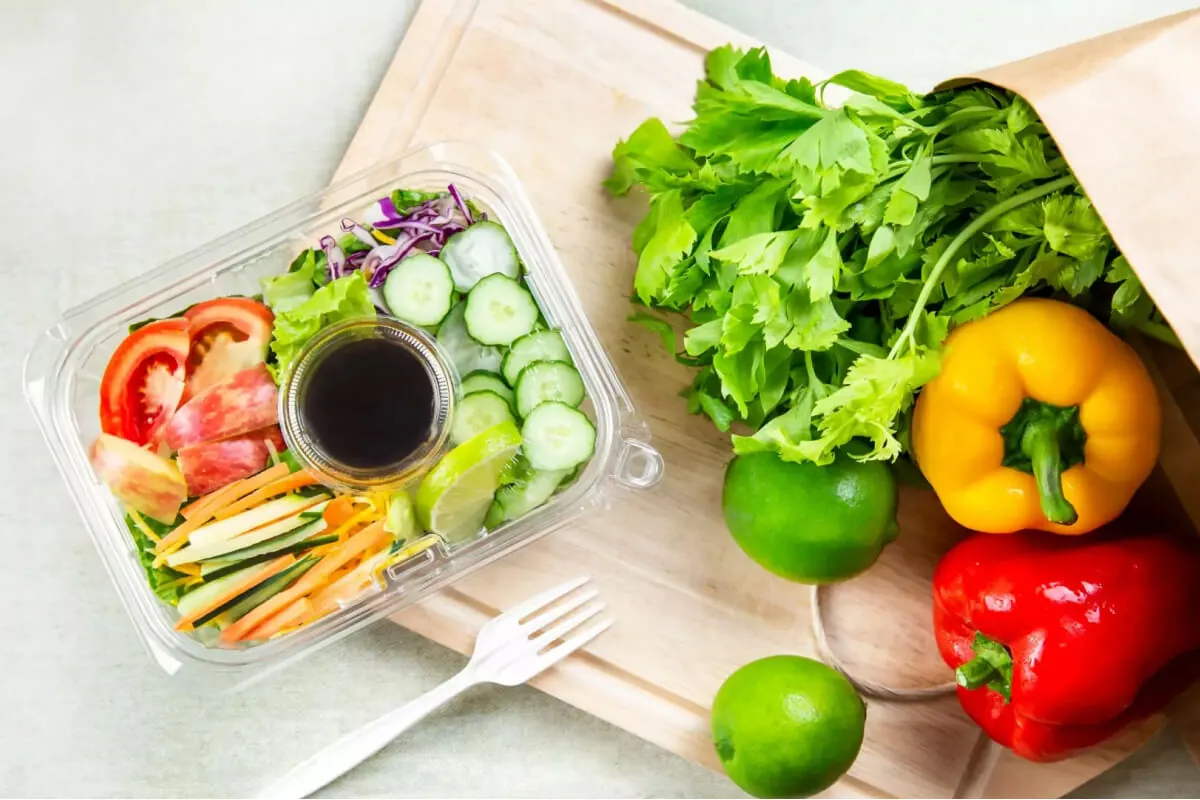
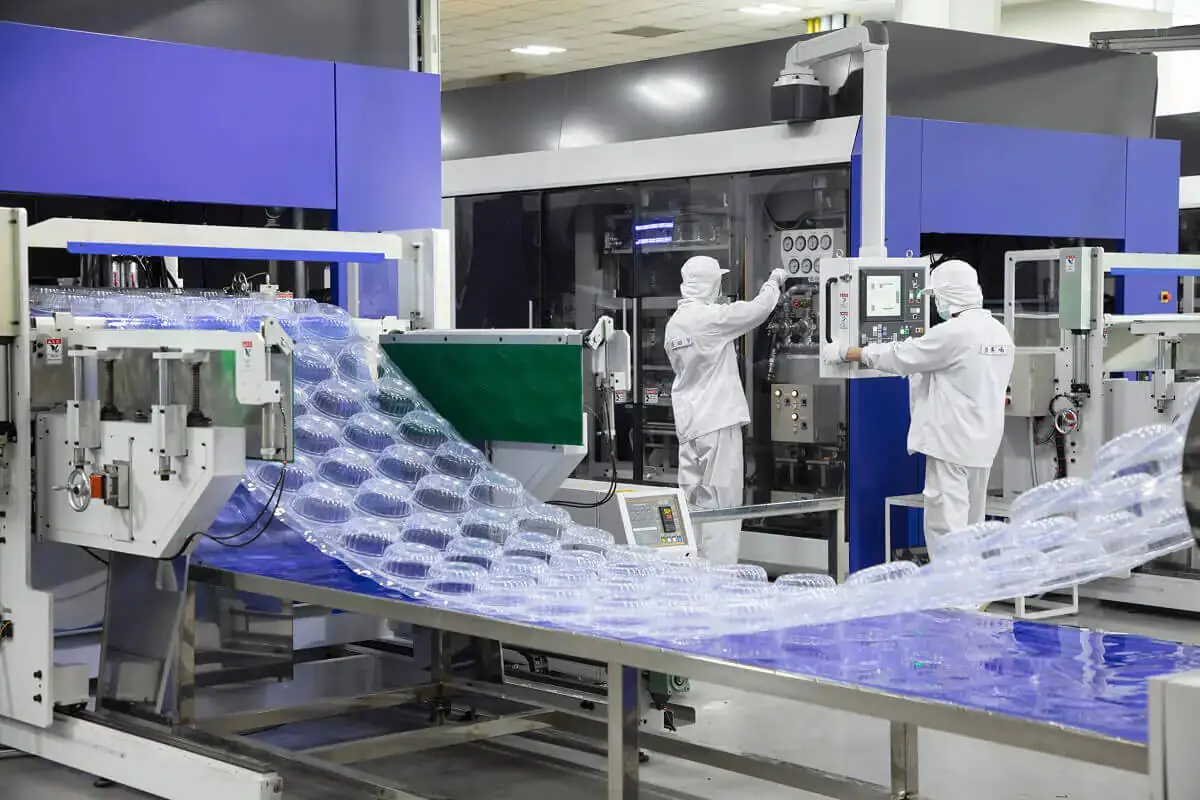
South Plastic Industry Co., Ltd. (SPI) has manufactured thermoformed plastic food packaging, since 1983. Our patented Safety Pack tamper evident packaging is used by supermarkets, convenience store chains and food service operators across North America, Europe, Australia and Japan.
Good food delivery packaging does four jobs. The lid shows if someone opened it. The seal holds when the bag tips over. The lid doesn’t fog up, so the customer can see what they ordered. And the plastic suits the food, which usually means polypropylene (PP) for anything that gets microwaved and PET or rPET for cold food that has to look fresh.
Table of Contents
What goes wrong with food between the kitchen and the customer
A delivered meal passes through at least two sets of hands the kitchen doesn’t control. It sits in a bag, in a car, for half an hour or more. Most complaints trace back to four failures, and each one points at a different part of the container.
Tampering.
In a 2019 survey of around 1,500 American adults, US Foods, the food service distributor, found that 28 percent of delivery drivers admitted to tasting food they were delivering. 85 percent of consumers said they wanted restaurants to use tamper-evident labels. The exact figures matter less than the point. The customer’s suspicion is the real problem, and only visible evidence that the container hasn’t been opened answers it. Our earlier guide to what tamper evident packaging is covers the principle; here we’re talking about applying it to delivery specifically.
Leaks.
Sauces, dressings and soups move around in transit. Even if a lid is secure and doesn’t pop open when the bag tilts, the container may not be 100% leak-proof. A thin flange will flex under a stack and let liquid seep past the seal. The fix is in the lid geometry.
Fogging and condensation.
Hot food fogs the lid of a closed container within minutes. Chilled salads and fruit sweat as they warm up on the way. A fogged lid hides the food and makes a fresh order look old before the customer has touched it, which is why anti-fog treatment gets specified for both hot and cold delivery containers.
Heat and reheating.
Customers reheat in whatever container they received. A PET container will warp in the microwave; a polypropylene (PP) one won’t. Operators tend to learn this from complaints, not from the specification sheet.
The common thread: the container has to do its work after the kitchen has lost sight of it. That’s why we’d suggest specifying delivery containers separately from dine-in or counter packaging, even when the food is the same.
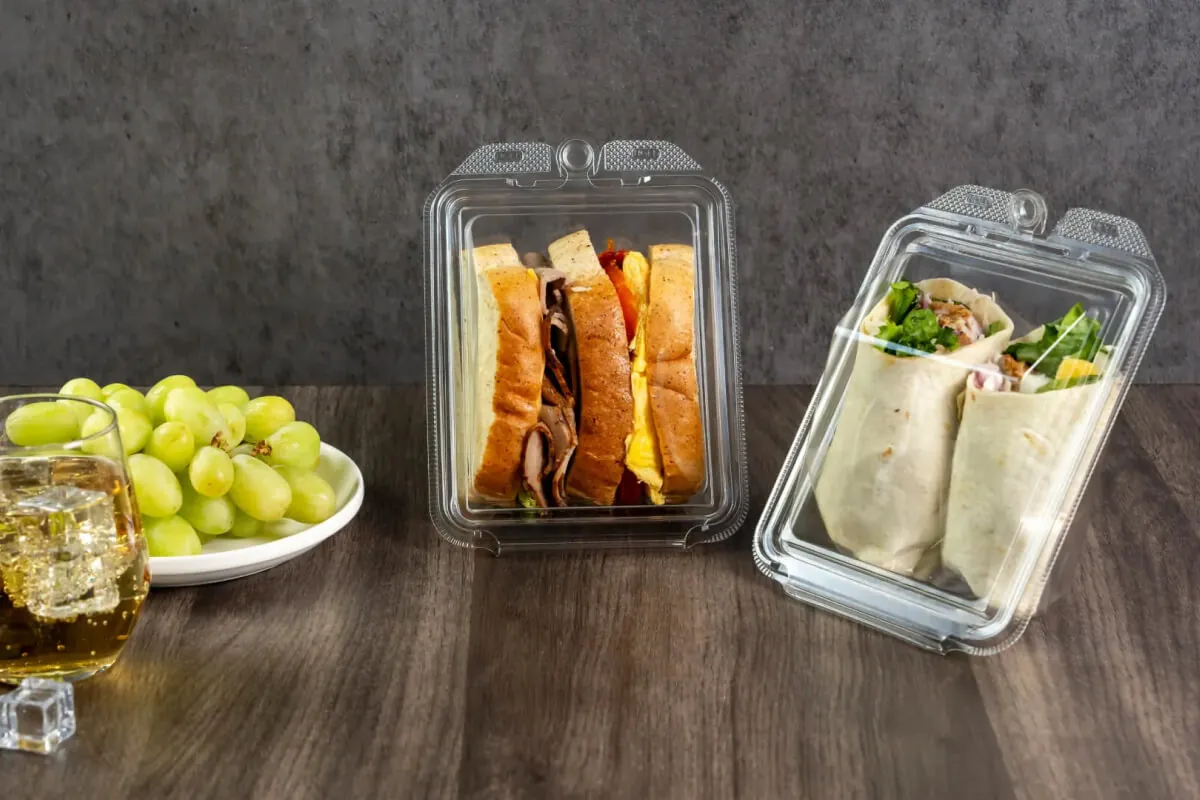
Where tamper-evident food delivery packaging is required
California requires a tamper-evident closure on every delivered order
California Assembly Bill 3336 took effect on 1 January 2021 and amended the California Retail Food Code to regulate third-party food delivery. Guidance from Ventura County Environmental Health puts the packaging rule simply: every bag or container of ready-to-eat food being transported to a customer must be closed by the food facility with a tamper-evident method before the deliverer takes possession. The guidance offers stickers or tape as examples; the law doesn’t prescribe a particular method. The law also requires food to be held at a safe temperature during transport unless delivered within 30 minutes.
For an operator in California this is a compliance question, and the choice is really between methods that fail at different rates. For operators elsewhere in the US, California rules tend to get copied. A container that satisfies the California requirement will almost certainly satisfy whatever comes next in another state.
Delivery platforms ask merchants to seal orders
Uber Eats’ community guidelines encourage merchants to seal packages in tamper-evident packaging before handover, and instruct delivery people not to tamper with or open packaging during delivery. It’s a recommendation, not a condition of listing. Even so, a sealed order gives the operator a clear position in any dispute over a missing or opened item, and that alone is usually reason enough. DoorDash and Grubhub publish similar merchant guidance. These pages change, so check the current version for your market.
Outside the United States, retailers set the requirement before regulators do
We’re not aware of a statutory tamper-evident requirement for delivered food in the United Kingdom, the European Union, Australia or Japan. In practice, the gap closes on its own. Supermarket and convenience store chains already specify tamper evidence for their grab-and-go and prepared ranges, and food service groups adopt it to protect their brand on delivery platforms. If you supply those customers, expect the requirement to show up in the customer’s specification well before it shows up in legislation.
Choosing a tamper-evident container for delivery
Containers compared with stickers, tape and bag seals
There are three ways to make a delivered order tamper evident, and they are not equal. Stickers and tape satisfy the letter of the California rule and cost very little per order, which is why most operators start there. A tamper-evident container builds the evidence into the lid itself.
| Sticker or tape over the lid | Sealed bag with tear strip | Tamper-evident container | |
|---|---|---|---|
| Where the evidence is | On the outside of the container | On the bag, not the food container | On the container holding the food |
| Can it be reapplied without trace? | Often, if lifted carefully or heated | No, but individual containers inside remain unsealed | No. The lock or hinge is visibly broken |
| Extra labour at pack-out | One or more stickers per container, by hand | One seal per bag | None. Closing the lid is the seal |
| Extra material | Sticker, backing paper | Bag plus strip | None. No tear-off strip on our design |
| Works for multi-item orders | Each container needs its own | Covers the bag, not the items | Each container is sealed on its own |
| Typical use | Restaurants complying with the California rule | Platform-branded delivery bags | Supermarket grab-and-go, deli, bakery, prepared meals |
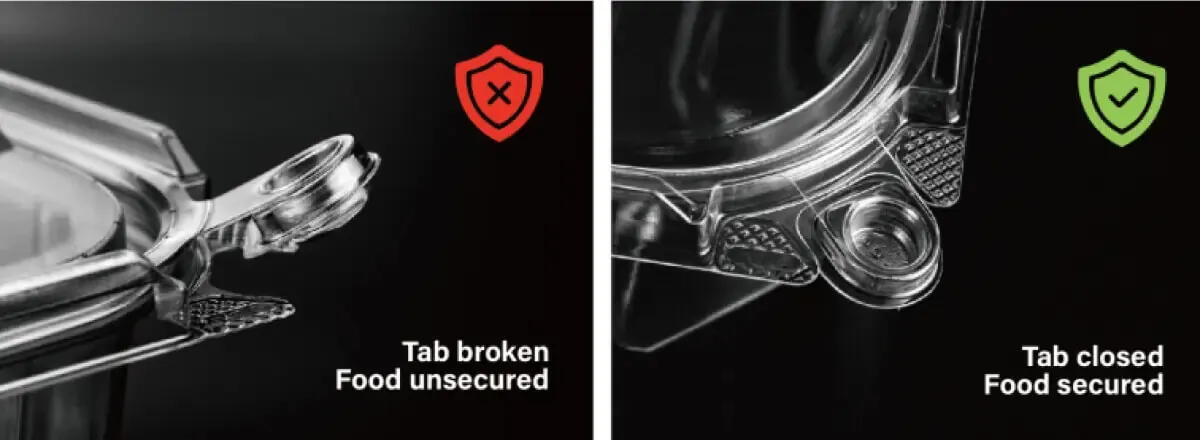
Stickers fail in two ways. Standard label adhesive is designed for room temperature, so on a cold or damp lid it doesn’t bond properly, and condensation forms a film between the sticker and the plastic. Label manufacturers say so themselves, which is why they sell cold-temperature and “aggressive adhesive” versions of the same tamper label. A lifted sticker creates a tampering complaint where nobody tampered. And a sticker is only as good as the person applying it at the busiest moment of the shift. A container that seals when the lid is pressed closed removes both problems, and takes the sticker out of the waste stream while it’s at it.
The Safety Pack lock is the mechanism we use across our hinged and two-piece tamper-evident ranges, and we’ve made the case for a tamper-evident food container over an added seal in more detail elsewhere. Once the lid closes, the lock engages. Opening it leaves a visible break that can’t be hidden, and there’s no tear-off strip, so no loose piece to dispose of and no extra material in the container.
A tamper-evident container costs more per unit than a plain container plus a sticker. Whether that’s worth it depends on volume and on who’s applying the sticker. A supermarket or food service group filling thousands of grab-and-go units a day on a line usually finds the labour saving settles the question on its own. At low volumes the arithmetic is less clear. If the numbers don’t justify it, we’d rather tell you that than oversell you a container.
Matching the material to the food
The material determines most of how the container behaves in transit. In practice the choice is between PET and PP.
Hot food, and anything the customer will reheat: use PP.
Our PP containers are rated to 110–120°C and are microwave safe, and PP tolerates a hot fill without distorting. Pair a PP base with an anti-fog lid, and specify a vented lid for fried food so steam escapes instead of softening the coating. Our microwave safe containers include sealed and take-out formats designed for exactly this.
Cold food where appearance sells: use PET or rPET.
PET is clearer than PP, so salads, fruit, sushi and desserts simply look better through the lid, and the anti-fog treatment keeps them visible when chilled. Don’t put PET in a microwave; it’s rated to about 60°C. If a cold item is likely to be reheated, that’s an argument for PP even at the cost of some clarity.
Grab-and-go and multi-component meals.
Hinged containers close in one movement, which matters on a fast pack-out line. Our grab-and-go range covers burrito and sandwich wedges and snack boxes. The two-piece range covers bakery boxes and rectangular meal containers where a separate lid is preferred.
One detail gets missed more than any other: stacking. Delivery bags are packed by weight, heaviest at the bottom. A container with a shallow lid recess or a weak corner will crush, and the one above it will tip. Ask the supplier for the stacking strength of the loaded container, not the empty one.
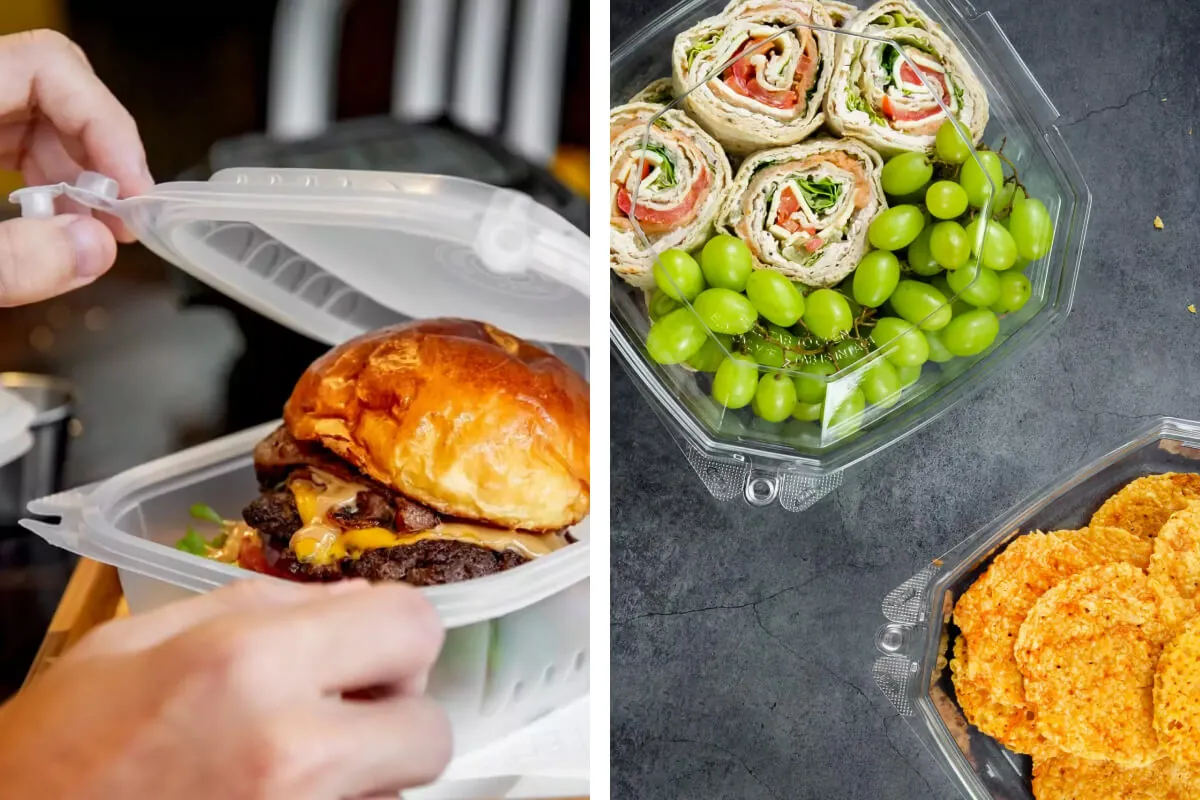
What to ask a food delivery packaging supplier
Five questions separate a container that performs in delivery from one that only performs on the shelf.
- How does the tamper evidence work, and can you show it broken? Ask for a sample, close it, open it, look. If the evidence depends on a sticker the supplier doesn’t make, you’re buying a plain container.
- What’s the heat rating of the base and the lid, and is it microwave safe? The answer should name the material and a temperature. Our Declaration of Compliance sets out heat resistance per material; any supplier should be able to do the same.
- Is the lid anti-fog, and for hot or cold service? Anti-fog treatments differ. Ask which condition it was designed for.
- What’s the stacking strength loaded, and what’s the case pack? Delivery bags and transport cartons are where containers fail.
- What food contact and food safety documentation comes with it? For the US, FDA food contact compliance under Title 21 of the Code of Federal Regulations. For the EU, Regulation (EU) 10/2011. Plus a food safety certificate for the factory. We manufacture under the BRCGS Global Standard for Packaging and Packaging Materials, Issue 7, which a buyer can verify on the BRCGS Directory. Our guide to food packaging certifications explains what each of these actually proves.
If you’re specifying containers for a delivery or grab-and-go programme and would like samples of our Safety Pack hinged or two-piece ranges, contact South Plastic with the foods, portion sizes and markets involved. We’ll suggest formats and send the documentation that goes with them.